
Short entry1.5 miles away
The Loons and Loch of Banks
Marwick · Freshwater wetland and marsh
 the ai birderBirding near me
The AI Birder · one-page field sheet
Marwick, Orkney, Scotland · KW17 2NB · KW17 2NB

Purple Sandpiper · Shag · Turnstone · Ringed Plover · Oystercatcher · Herring Gull
Kitchener Memorial — official clifftop viewpoint · Marwick Bay car park — Choin outlook · Marwick Bay to clifftop — public grassy trail
Check current access, hide closures and operator notices before travelling. Seasonal birds are possibilities, not promised sightings. Keep to authorised routes and give wildlife space.
Opening and charges checked 2026-10-25. Operator: https://www.rspb.org.uk/days-out/reserves/marwick-head
Full guide and current source links: https://aibirder.co.uk/reserves/rspb-marwick-head
SC 20 · RSPB reserve guide
Marwick, Orkney, Scotland · KW17 2NB
Guillemot, Fulmar, Purple sandpiper
Decide if the visit fits.
Last checked 18 October 2026.
Opening and charges information · checked .
Stay nearby →Reserve overview
Guillemot, Fulmar, Purple sandpiper
Eight checks for a smoother visit.
Conditions change: check the operator and transport notices before travelling.
January: January usually favours the lower Choin outlook at Marwick Bay car park for Turnstone, Purple Sandpiper and Ringed Plover. Choose a calm interval with safe dry footing. The winter shore is a different visit from the summer seabird colony, and a short watch can be more useful than an exposed climb.
February: In February, watch Purple Sandpiper and Turnstone from the Choin car-park outlook and listen for Rock Pipit along the public grassy approach. Fulmars may return to the cliffs, but wind and swell determine whether the upper walk is sensible. Do not make a clifftop visit a fixed obligation.
March: March typically brings more spring activity without the full auk spectacle. Try the Choin outlook for Shelduck and Oystercatcher, then the public approach for Rock Dove and Rock Pipit. If conditions allow the climb, scan for Fulmar from the official Kitchener Memorial viewpoint, well away from edges.
April: April usually makes the Kitchener Memorial viewpoint increasingly worthwhile for returning Guillemot, Razorbill and Kittiwake. Use binoculars first and a scope only from a stable safe position. Down at Choin, Shelduck and Ringed Plover offer a gentler alternative if sea spray or gusts make the climb unattractive.
May: May is our choice for combining the seabird colony with the bay. Watch Guillemot, Kittiwake, Razorbill, Fulmar and Shag from the official Kitchener Memorial viewpoint. Puffin is present in smaller numbers rather than the main spectacle. Check Choin for Shelduck without approaching any breeding or resting birds.
June: In June, the Kitchener Memorial viewpoint gives the broad colony experience: Guillemot and Kittiwake first, with Razorbill, Fulmar, Shag and smaller numbers of Puffin to search for patiently. Rock Pipit and Rock Dove can be watched along the established approach. Keep dogs close and give all nesting ground space.
July: July usually remains useful for auks at the official clifftop viewpoint, though departures begin and exact timing varies. Watch Guillemot and Razorbill on the sea as well as the cliffs. Use the grassy public trail for Rock Pipit and Oystercatcher, with no attempt to follow adults towards nests.
August: August typically marks the change away from packed auk ledges. Kittiwake and Fulmar may still reward the Kitchener Memorial viewpoint while returning Turnstone adds interest at Choin. Do not judge the bay by the absence of June’s colony activity; choose the lower watch if the exposed route is uncomfortable.
September: September usually suits a slower Choin watch for Turnstone, Ringed Plover and Herring Gull, with Rock Pipit along the public grassy approach. The colony is no longer the principal reason to visit. Read the tide alongside swell and wind rather than walking out towards birds on newly exposed shore.
October: In October, winter waders become a more useful focus. Try the Marwick Bay car-park outlook for Purple Sandpiper, Turnstone and Ringed Plover. Stay back from resting groups, particularly as rising water reduces their choices. A forecast allowing brief clear intervals may suit the sheltered vehicle-based plan better than the upper walk.
November: November usually favours a compact lower-shore visit: Purple Sandpiper and Turnstone at Choin, with Rock Dove or Rock Pipit along the first public path section. Bring a scope if available for distant birds. There is no enclosed hide, so finish the visit before cold hands or unstable footing become distracting.
December: December is a month for choosing safety and light before distance. Watch Ringed Plover, Purple Sandpiper and Turnstone from the Choin outlook where conditions permit. The reserve’s open status does not make icy grass, a cliff edge or storm-driven water safe, and there is no requirement to complete the circular walk.
Best conditions: Choose clear visibility and modest wind for the exposed clifftop. Our morning-light preference follows the mapped west-facing coast and is practical inference, not an operator promise about every ledge. A scope helps compare the colony from the safe official viewpoint; binoculars suit Rock Pipit along the approach. Strong gusts, slippery grass or Atlantic swell favour a short Choin watch from safe dry public ground, or postponing altogether.
Admission checked 18 October 2026: the RSPB lists free entry for adults and children, including non-members. There is no ordinary admission booking requirement. Make a first visit in daylight so that the grassy climb and coastal route are easy to judge. The operator identifies parking at Marwick Bay and an alternative small area at Cumlaquoy with room for about six cars. Its charges page does not state a separate parking price; establish any current vehicle charge before travelling rather than assuming a blank tariff means free parking. The generic suggestion to pay at a visitor centre is inconsistent with the facilities page's explicit statement that there is no centre; reserve admission itself is clearly free. Read the current RSPB notices and weather forecast before setting out, especially when a clifftop walk is central to the visit.
Access times: Reserve: Current RSPB calendar lists nature reserve open 24 hours; choose a safe daylight visit in exposed conditions. · Hides: No enclosed hides. Official colony viewpoint at the Kitchener Memorial; Choin can be watched from Marwick Bay car park. · Car park: Marwick Bay and Cumlaquoy parking are listed; no separate gate hours published or overnight permission verified. Both are unlit. · Dawn access: partly. Operator opening information.
The RSPB describes a 2.5-mile circular walk from Marwick Bay up to the clifftop, returning along single-track roads. A shorter approach starts at Cumlaquoy, about half a mile each way to the cliff top. Use the information boards at the car parks to decide which route suits your time and conditions. The walk from the bay gives a gradual change from shore watching to the seabird colony and the Kitchener Memorial viewpoint. The Choin is the bay's low-tide lagoon, where waders and ducks can be watched from the car park area. This is a worthwhile destination in its own right, particularly outside the colony season. There are no enclosed hides or formal sheltered viewing structures. Keep a safe distance from cliff edges, and choose a stopping point that lets other walkers pass without squeezing towards the drop. Birds moving below you can be followed with binoculars from a secure position. Two-hour plan, editorial suggestion: choose either the shore and part of the bay route, or the shorter Cumlaquoy approach with a sustained colony watch. Trying to fit the full circular route into a tight window leaves little time to study birds. At the shore, compare feeding and resting areas; at the cliff, watch one stretch of ledges carefully rather than attempting a complete count. Full-day plan, editorial suggestion: begin with the Choin and Marwick Bay, then follow the circular route when conditions are suitable, taking a packed lunch break in a safe place away from the edge. Give the memorial viewpoint a generous watch and return with time for another shore session. Alternatively, split the day into two shorter visits around the most useful tide and light. This allows the landscape's different habitats to shape the outing without making a long exposed walk compulsory.
Use the linked reserve map and directions with current access notices. Species are typical seasonal targets. Light and telescope advice reflects our choice of viewpoint.
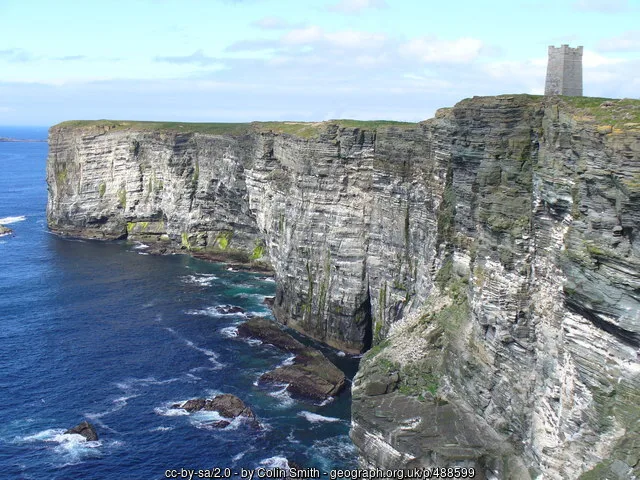
The seabird cliffs and adjacent sea
Stay on the public clifftop route and well back from edges. The approach is grassy, steep and slippery when wet; two narrow kissing gates affect the longer route.
Spring: Guillemot, Kittiwake, Razorbill, Fulmar, Shag
Summer: Guillemot, Kittiwake, Razorbill, Puffin, Fulmar, Shag
Light: morning. Scope: useful.
The low-tide lagoon and shore visible without entering the bird area
Rough hardcore parking surface; use a stationary outlook from dry public ground and do not approach a resting flock.
Winter: Turnstone, Purple Sandpiper, Ringed Plover
Spring: Shelduck, Oystercatcher, Herring Gull, Common Gull
Summer: Shelduck, Oystercatcher, Lesser Black-backed Gull
Autumn: Turnstone, Ringed Plover, Herring Gull
Light: either. Scope: useful.
Tide: The operator identifies Choin as a low-tide lagoon. Watch feeding margins as water falls; give resting birds space at every state.
Coastal grassland, rocks and the bay-side approach
This is a path section, not a formal hide. No off-path approaches to cliff ledges or concealed breeding birds.
Winter: Rock Dove, Rock Pipit, Herring Gull
Spring: Rock Dove, Rock Pipit, Oystercatcher
Summer: Rock Dove, Rock Pipit, Oystercatcher
Autumn: Rock Dove, Rock Pipit
Light: either. Scope: not needed.
| Spot | Overlooks | Key species by season | Best light | Scope | Tide |
|---|---|---|---|---|---|
| Kitchener Memorial — official clifftop viewpointStay on the public clifftop route and well back from edges. The approach is grassy, steep and slippery when wet; two narrow kissing gates affect the longer route. | The seabird cliffs and adjacent sea | Spring: Guillemot, Kittiwake, Razorbill, Fulmar, Shag Summer: Guillemot, Kittiwake, Razorbill, Puffin, Fulmar, Shag | morning | useful | — |
| Marwick Bay car park — Choin outlookRough hardcore parking surface; use a stationary outlook from dry public ground and do not approach a resting flock. | The low-tide lagoon and shore visible without entering the bird area | Winter: Turnstone, Purple Sandpiper, Ringed Plover Spring: Shelduck, Oystercatcher, Herring Gull, Common Gull Summer: Shelduck, Oystercatcher, Lesser Black-backed Gull Autumn: Turnstone, Ringed Plover, Herring Gull | either | useful | The operator identifies Choin as a low-tide lagoon. Watch feeding margins as water falls; give resting birds space at every state. |
| Marwick Bay to clifftop — public grassy trailThis is a path section, not a formal hide. No off-path approaches to cliff ledges or concealed breeding birds. | Coastal grassland, rocks and the bay-side approach | Winter: Rock Dove, Rock Pipit, Herring Gull Spring: Rock Dove, Rock Pipit, Oystercatcher Summer: Rock Dove, Rock Pipit, Oystercatcher Autumn: Rock Dove, Rock Pipit | either | not needed | — |
Month chips show typical presence or our preferred viewing season. Choose birds that suit the time of your visit.
The operator describes Choin as a low-tide lagoon. Our choice is a safe car-park shore scan as falling water reveals feeding edges; never approach a roost, enter the lagoon or let rising water isolate a watching position. No published minimum height was found.
The route to the cliff top is grassy and includes steep inclines. The RSPB warns that it can be wet and slippery, with two narrow kissing gates on the latter part of the trail. These features make the climb a substantially different proposition from watching at the bay. If you use a wheelchair, scooter or pushchair, discuss the exact approach with the Orkney reserve team before travelling rather than assuming that a short route is step-free. Both parking areas have rough surfaces; Marwick Bay is described as hardcore. There are no height restrictions or lighting. One seat is located along the trail near the Choin, but a rest point should not be assumed wherever a longer climb becomes tiring. Consider wind exposure, balance and how you would retrace the route if conditions deteriorate. The nearest accessible toilets identified by the RSPB are RADAR facilities at the Bay of Skaill, about 4.1 miles south. The operator does not identify nearby baby-changing provision. A shore watch may provide a useful lower-level alternative, but confirm what surface and vehicle access will suit your needs before treating it as a fully accessible substitute for the cliff route.
Marwick has no staffed visitor centre, café or shop. Bring food, water and warm clothing suitable for standing in an open coastal setting. The RSPB identifies ordinary public toilets at Palace Village in Birsay, around four miles away, and refreshments in Birsay or Skara Brae. There is no shelter at the viewing areas, so a waterproof cover for optics and a bag for carrying litter away are useful. Keep any picnic away from birds' feeding and resting places.
Follow the Scottish Outdoor Access Code and keep dogs close, preferably on a short lead, during the RSPB's stated ground-nesting season of 1 April–15 August. Clear up after them and maintain safe control near the cliff. Visitors with assistance dogs are welcome at RSPB Marwick Head, including throughout its visitor routes.
NorthLink sails from Scrabster to Stromness and from Aberdeen to Orkney's Hatston terminal on its Northern Isles route. Loganair serves Kirkwall by air; its current destination information lists links with Sumburgh, Inverness, Glasgow and Edinburgh, alongside seasonal Dundee flights. Compare your arrival port or airport with the onward journey before choosing accommodation, and leave a weather margin around the return sailing or flight. For the local approach, Orkney Islands Council's winter 2026 guide lists service 8S via Marwick Junction on selected days. The RSPB's older location text calls the bus route 8; use the current 8S timetable and confirm the walking connection from the road junction, which the reserve page describes as about 0.8 mile to the Choin car park. Service 8 is now described by the council as a school service. A pre-booked taxi from Stromness or Kirkwall may suit a fixed watching window better. Drivers use the B9056 between Skaill and Birsay, following the brown reserve sign. National Cycle Network route 1 passes close to the reserve.
Useful bases for an early start.
Booking.com links are affiliate links: we may earn a commission at no extra cost to you. How these links work.
About 4.7 miles by road, roughly 11 minutes' drive (OSRM estimate, measured 18 October 2026; not live traffic).
Measured driving route · 18 October 2026. Map estimates exclude live traffic.
A nearby west-mainland base for repeated shore and cliff visits.Find places to stay in Birsay on Booking.comAbout 11.8 miles by road, roughly 23 minutes' drive (OSRM estimate, measured 18 October 2026; not live traffic).
Measured driving route · 18 October 2026. Map estimates exclude live traffic.
The NorthLink arrival town for the Scrabster ferry.Find places to stay in Stromness on Booking.comAbout 21.6 miles by road, roughly 35 minutes' drive (OSRM estimate, measured 18 October 2026; not live traffic).
Measured driving route · 18 October 2026. Map estimates exclude live traffic.
An Orkney town base for air arrivals and wider island journeys.Find places to stay in Kirkwall on Booking.comExplore Orkney’s full guides and smaller birding sites
The RSPB Orkney team can be contacted at orkney@rspb.org.uk or 01856 850176. The published address is Marwick Head, Orkney, KW17 2NB. Describe whether you plan to use Marwick Bay or Cumlaquoy when requesting route advice, and give any equipment or gate-width needs clearly. The operator's location and facilities pages explain the two approaches, while the council's current bus guide is the better source for selecting a dated car-free connection.
Check SOC — completed 2026 spring migrant records for Orkney and other recording areas. completed 2026 season, data to 9 June; not a live reserve feed Reports show what has been seen, not what will be.
Follow the BTO Birders’ Code and give wildlife space.
RSPB Marwick Head: Free entry; see operator for parking.
RSPB Marwick Head: Follow the Scottish Outdoor Access Code and keep dogs close, preferably on a short lead, during the RSPB's stated ground-nesting season of 1 April–15 August.
RSPB Marwick Head: Spring and summer seabird colony · winter coastal birds.
RSPB Marwick Head: If you use a wheelchair, scooter or pushchair, discuss the exact approach with the Orkney reserve team before travelling rather than assuming that a short route is step-free.
RSPB Marwick Head: NorthLink sails from Scrabster to Stromness and from Aberdeen to Orkney's Hatston terminal on its Northern Isles route.
Shorter stops within 15 miles in a straight line. Use the operator’s arrival directions for the journey.
Marwick · Freshwater wetland and marsh
Evie · Moorland and blanket bog
Stennes · Grassland and freshwater lochs
Brinian · Moorland and wet heath
Hobbister · Moorland and coastal shore
Nearby complete guides.
Stops with a purpose: use one as a contrasting habitat or weather-proof Plan B. Distances are straight-line estimates, not road journeys.