
Short entry1.4 miles away
Cannop Bridge Marsh
Cannop Ponds car park approach, Forest of Dean · Marsh, meandering streams, alder and birch woodland
 the ai birderBirding near me
The AI Birder · one-page field sheet
Parkend, Forest of Dean, Gloucestershire · GL15 4LA

Current planning alert (2026-10-18): Campbell Hide is unstable and dangerous. The RSPB says not to walk up to or use it. Use open public trails and viewing positions.
Great Spotted Woodpecker · Green Woodpecker · Nuthatch · Treecreeper · Crossbill · Mandarin Duck
Short Trail: oak woodland · Long Trail: woodland and conifers · Lower Hide · Nursery Pond public viewing area · Campbell Hide — CLOSED
Check current access, hide closures and operator notices before travelling. Seasonal birds are possibilities, not promised sightings. Keep to authorised routes and give wildlife space.
Opening and charges checked 2026-10-18. Operator: https://www.rspb.org.uk/days-out/reserves/nagshead
Full guide and current source links: https://aibirder.co.uk/reserves/rspb-nagshead
EN 90 · RSPB reserve guide
Parkend, Forest of Dean, Gloucestershire
Spring Pied Flycatchers, Redstarts and woodland birds
For a spring woodland comparison at Nagshead, read about Pied Flycatchers, Redstarts and Wood Warblers and match their listening seasons to the reserve’s public trails.
Decide if the visit fits.
Last checked 18 October 2026.
Campbell Hide is unstable and dangerous. The RSPB says not to walk up to or use it. Use open public trails and viewing positions.
Opening and charges information · checked .
Stay nearby →Reserve overview
Spring Pied Flycatchers, Redstarts and woodland birds
Eight checks for a smoother visit.
Conditions change: check the operator and transport notices before travelling.
January: Typically start along Short Trail: oak woodland for Nuthatch and Great Spotted Woodpecker. Bare branches can help observation, but keep the visit short if falling branches or strong gusts make woodland paths unsafe.
February: Usually try Long Trail: woodland and conifers for Treecreeper and listen for Crossbill overhead. These are mobile woodland birds, so a quiet pause is more useful than following a flock off the trail.
March: Typically listen for Great Spotted Woodpecker from Short Trail: oak woodland while watching Nuthatches on the trunks. Goshawk remains a sensitive, unlocated target; watch woodpeckers from the public trails without seeking nests.
April: Usually watch the oak canopy from Short Trail: oak woodland as Pied Flycatcher and Redstart return. Arrival dates vary; avoid examining nest boxes or using recordings to pull birds towards the path.
May: Typically the strongest spring combination is Wood Warbler and Pied Flycatcher along Short Trail: oak woodland. The May 2026 local-group list also recorded Spotted Flycatcher; a report is evidence, not a promise.
June: Usually give Short Trail: oak woodland time for Wood Warbler and Redstart, then try Lower Hide for Mandarin Duck. Stay in the public hide and allow birds to feed undisturbed.
July: Typically the canopy becomes harder to read; watch patiently from Long Trail: woodland and conifers for Spotted Flycatcher or Chiffchaff. Lower Hide provides a quieter alternative for Mandarin Duck and Great Tit.
August: Usually start with resident birds rather than expecting the spring song display. Nuthatch along Short Trail: oak woodland and Mandarin Duck at Lower Hide remain sensible targets with patience and suitable weather.
September: Typically compare Nuthatch and Treecreeper from Short Trail: oak woodland. Mixed parties can move quickly through the canopy: stay on the route and wait for the next group rather than pursuing them.
October: Usually take a slow woodland circuit, using Long Trail: woodland and conifers for Treecreeper and Crossbill. Cone crops and flock movements affect Crossbill encounters; the month chips describe typical opportunities, not fixed occupancy.
November: Typically watch Nuthatch from Short Trail: oak woodland and inspect trunks for Treecreeper along Long Trail: woodland and conifers. A settled dry morning is our choice; turn back in unsafe wind or poor footing.
December: Usually plan a short daylight visit to Short Trail: oak woodland for Great Spotted Woodpecker and Nuthatch. Campbell Hide remains excluded: a quiet winter visit does not make its dangerous access permissible.
Best conditions: Our choice is a calm dry morning, listening before moving and scanning trunks before the upper canopy. A telescope is unnecessary for most woodland viewing; binoculars are easier to manoeuvre. Light ratings are editorial rather than promised sun directions. Strong wind can conceal calls and increase branch-fall risk; never approach a nest box or use playback.
RSPB Nagshead has free adult and child admission in the charges information checked on 18 October 2026. Forestry England separately confirms no parking charges. The RSPB calendar lists the reserve as open 24 hours but the car park from 8.30am to dusk. Use the signed entrance from Coleford Road west of Parkend, GL15 4LA. The visitor centre and toilets are seasonal rather than guaranteed daily facilities. Official entries conflict: the toilet information gives 11am–3pm at weekends and bank holidays between Easter and September, while the baby-changing entry gives 10am–4pm for the same period. They are closed outside that season, so an October visit should be planned as a woodland outing without an operating centre. Check the reserve page before departure for route and facility changes. The specific Campbell Hide closure notice takes precedence over the calendar's generic open-hide entry.
Access times: Reserve: The operator calendar lists 24-hour reserve access; use open signed paths and respect storm or forestry closures. · Hides: Lower Hide listed open 24 hours in the operator calendar. Campbell Hide is CLOSED and dangerous; the main reserve notice overrides its older facilities description. · Car park: 8.30am–dusk in the operator calendar; do not assume vehicle access at dawn. · Dawn access: partly. Operator opening information.
Nagshead's mature oak woodland is the main attraction, with conifers and more open patches changing both the soundscape and the birds. Two circular waymarked trails begin near the visitor centre. Choose the shorter or longer option according to the ground, daylight and time you want to spend standing still; a woodland birdwatching walk rarely follows the pace of an ordinary exercise circuit. Use open official viewing positions and the marked paths. In spring, the woodland itself can be more productive than a hide, especially when listening for flycatchers, Redstarts and Wood Warblers. Do not use playback to bring a bird closer or linger beside nest boxes. In any season, identify a call's direction first and watch a broad area of branches, allowing the bird to move into view. Two-hour plan: take the Short Trail slowly, concentrating on several quiet listening stops and an extended watch wherever a feeding flock is active. Return by the signed route, leaving time for another look at the woodland edge instead of making a hurried additional loop. Full-day plan: begin with the shorter circuit to establish the day's activity, pause for lunch, then use the Long Trail if it is suitable. Compare oak woodland and conifer sections, revisit a promising place in different light and allow generous time for identification. A full day need not involve finding a scarce species: watching Nuthatches, Treecreepers and woodpeckers use different parts of the same tree is rewarding in its own right. Keep to any signed diversions and do not improvise a shortcut through management areas or towards an unavailable hide.
Use the linked reserve map and directions with current access notices. Species are typical seasonal targets. Light and telescope advice reflects our choice of viewpoint.
Mature oak canopy and woodland floor from the waymarked circular trail
Unsurfaced one-mile circular trail, with slopes and gates. Watch from the path without inspecting occupied nest boxes.
Winter: Nuthatch, Treecreeper, Great Spotted Woodpecker
Spring: Pied Flycatcher, Redstart, Wood Warbler, Blackcap, Lesser Spotted Woodpecker
Summer: Spotted Flycatcher, Great Spotted Woodpecker, Green Woodpecker, Lesser Spotted Woodpecker
Autumn: Nuthatch, Treecreeper
Light: either. Scope: not needed.
Oak woodland and conifer canopy beside the longer waymarked trail
The 2.25-mile route includes steeper slopes, uneven ground and narrow sections.
Winter: Treecreeper, Crossbill
Spring: Pied Flycatcher, Wood Warbler, Firecrest
Summer: Spotted Flycatcher, Chiffchaff
Autumn: Nuthatch, Crossbill
Light: either. Scope: not needed.
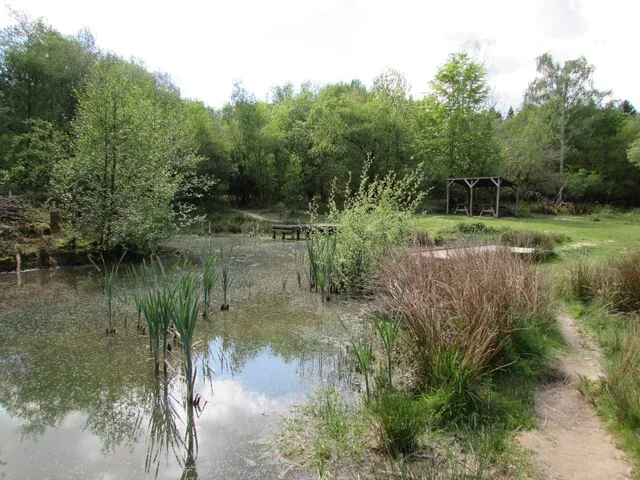
Lower Pond and the immediate wooded pond margin
Within 500m of the centre; unsurfaced gated approach, ramp without handrail.
Spring: Mandarin Duck
Summer: Mandarin Duck, Robin, Great Tit, Long-tailed Tit
Light: either. Scope: not needed.
Nursery Pond and woodland edge from the public hard-surfaced approach
The RSPB confirms open viewing here but the reviewed sources did not attribute named birds to this pond; do not confuse it with Lower Pond.
Light: either. Scope: not needed.
Former elevated woodland-pond view; this is not an available watching stop
CLOSED and dangerous: the current RSPB notice says not to walk up to or use this hide.
Light: either. Scope: not needed.
| Spot | Overlooks | Key species by season | Best light | Scope | Tide |
|---|---|---|---|---|---|
| Short Trail: oak woodlandUnsurfaced one-mile circular trail, with slopes and gates. Watch from the path without inspecting occupied nest boxes. | Mature oak canopy and woodland floor from the waymarked circular trail | Winter: Nuthatch, Treecreeper, Great Spotted Woodpecker Spring: Pied Flycatcher, Redstart, Wood Warbler, Blackcap, Lesser Spotted Woodpecker Summer: Spotted Flycatcher, Great Spotted Woodpecker, Green Woodpecker, Lesser Spotted Woodpecker Autumn: Nuthatch, Treecreeper | either | not needed | — |
| Long Trail: woodland and conifersThe 2.25-mile route includes steeper slopes, uneven ground and narrow sections. | Oak woodland and conifer canopy beside the longer waymarked trail | Winter: Treecreeper, Crossbill Spring: Pied Flycatcher, Wood Warbler, Firecrest Summer: Spotted Flycatcher, Chiffchaff Autumn: Nuthatch, Crossbill | either | not needed | — |
| Lower HideWithin 500m of the centre; unsurfaced gated approach, ramp without handrail. | Lower Pond and the immediate wooded pond margin | Spring: Mandarin Duck Summer: Mandarin Duck, Robin, Great Tit, Long-tailed Tit | either | not needed | — |
| Nursery Pond public viewing areaThe RSPB confirms open viewing here but the reviewed sources did not attribute named birds to this pond; do not confuse it with Lower Pond. | Nursery Pond and woodland edge from the public hard-surfaced approach | — | either | not needed | — |
| Campbell Hide — CLOSEDCLOSED and dangerous: the current RSPB notice says not to walk up to or use this hide. | Former elevated woodland-pond view; this is not an available watching stop | — | either | not needed | — |
Month chips show typical presence or our preferred viewing season. Choose birds that suit the time of your visit.
The RSPB gives the two waymarked circuits as one mile or 1.5 km and 2.25 miles or 3.5 km. Both are unsurfaced and include steep slopes; the longer route has additional narrow sections and longer slopes. Swing gates and kissing gates occur. Rain can make the ground soft and uneven, so a general description of a woodland walk should not be taken as a level accessible circuit. The main parking area has about 20 spaces in unmarked bays, with a rolled-stone surface and loose material, on a gentle slope. A vehicle can drop off in front of the visitor centre if required. The RSPB also identifies five additional spaces at Russell's Enclosure, but these are not a reason to assume an equivalent trail approach for every visitor. Discuss a specific route with the reserve if using a wheelchair, mobility scooter or pushchair. Explain the gradients, surface and gate clearances you can manage, rather than requesting only a yes-or-no accessibility assessment. Plan a comfortable turnaround point before a steep section. When seasonal visitor facilities are unavailable, the operator points to Parkend station for accessible toilets, subject to that venue's arrangements.
The reserve has visitor information and picnic opportunities but should be approached as a woodland site with limited seasonal support. Bring refreshments and drinking water rather than relying on a café. Baby-changing provision is associated with the seasonal visitor building; the RSPB names Norchard Steam Centre as an alternative outside its opening period. Barbecues are not permitted. Keep picnic waste secure and take it away so food does not attract animals around paths and parking.
Dogs must remain on a short lead throughout Nagshead, as required by the RSPB to protect wildlife, habitats and livestock. Visitors with assistance dogs are welcome at RSPB Nagshead. Keep a dog close when stopping to watch birds, and do not let it enter undergrowth or approach other visitors at a viewing point.
Lydney is the nearest mainline station identified by the RSPB, about 3.75 miles or six kilometres away. A prebooked taxi to the reserve entrance is a straightforward car-free option. Parkend's heritage railway is a separate visitor attraction and should not be assumed to provide a daily mainline connection for a birdwatching arrival. The RSPB identifies bus stops in Parkend by the cricket pitch and guesthouses but does not give a current route number on its location page. The published Stagecoach timetable feed reports service 23 through Parkend on the Gloucester–Lydney–Coleford corridor; check the operator's chosen-day timetable for the outward and return journeys. The final approach to the reserve remains a walk from the village, so include it when deciding how much woodland route to attempt. Nagshead connects with the wider Forest of Dean cycle network, but cycling within the reserve is prohibited. Leave a bicycle appropriately before joining the pedestrian trails.
Useful bases for an early start.
Booking.com links are affiliate links: we may earn a commission at no extra cost to you. How these links work.
About 1 miles by road, roughly 5 minutes’ drive to the reserve visitor approach. OSRM measured the Parkend journey for RSPB Nagshead on 18 October 2026; the estimate excludes live traffic.
Measured driving route · 18 October 2026. Map estimates exclude live traffic.
A village base beside the Nagshead approach for woodland-focused days.Find places to stay in Parkend on Booking.comAbout 4 miles by road, roughly 10 minutes’ drive to the reserve visitor approach. OSRM measured the Coleford journey for RSPB Nagshead on 18 October 2026; the estimate excludes live traffic.
Measured driving route · 18 October 2026. Map estimates exclude live traffic.
A Forest of Dean town base north-west of Nagshead.Find places to stay in Coleford on Booking.comAbout 4.5 miles by road, roughly 11 minutes’ drive to the reserve visitor approach. OSRM measured the Lydney journey for RSPB Nagshead on 18 October 2026; the estimate excludes live traffic.
Measured driving route · 18 October 2026. Map estimates exclude live traffic.
A mainline-rail base south of the woodland reserve.Find places to stay in Lydney on Booking.comExplore Gloucestershire’s full guides and smaller birding sites
Contact nagshead@rspb.org.uk or 01594 562852. Give the reserve name when asking about current woodland access, a group visit or seasonal building availability. The RSPB supplies the visitor-trail and wildlife information, while Forestry England is an additional official source for this jointly managed woodland setting. For access-dependent visits, describe the intended route and equipment clearly. Report any damaged structure to the operator from a safe place, without approaching it to obtain a closer photograph.
Check RSPB Gloucestershire: actual Nagshead 16 May 2026 species list. irregular trip reports Reports show what has been seen, not what will be.
Follow the BTO Birders’ Code and give wildlife space.
RSPB Nagshead: Free entry and parking.
RSPB Nagshead: Dogs must remain on a short lead throughout Nagshead, as required by the RSPB to protect wildlife, habitats and livestock.
RSPB Nagshead: All year; May–June Pied Flycatchers and spring song.
RSPB Nagshead: Rain can make the ground soft and uneven, so a general description of a woodland walk should not be taken as a level accessible circuit.
RSPB Nagshead: Lydney is the nearest mainline station identified by the RSPB, about 3.75 miles or six kilometres away.
Shorter stops within 15 miles in a straight line. Use the operator’s arrival directions for the journey.
Cannop Ponds car park approach, Forest of Dean · Marsh, meandering streams, alder and birch woodland
Near Trellech, Monmouthshire · Ancient coppiced woodland and streams
Churcham · Ancient woodland
Coed-Cwner near Usk, Monmouthshire · Pasture, hay meadow and ancient woodland
Nearby complete guides.
Stops with a purpose: use one as a contrasting habitat or weather-proof Plan B. Distances are straight-line estimates, not road journeys.