
Short entry7.9 miles away
Cannop Bridge Marsh
Cannop Ponds car park approach, Forest of Dean · Marsh, meandering streams, alder and birch woodland
 the ai birderBirding near me
The AI Birder · one-page field sheet
Slimbridge, Gloucestershire, England · GL2 7BT · GL2 7BT

White-fronted Goose · Crane · Avocet · Wigeon · Teal · Shoveler
Peng Observatory · Rushy Hide · Martin Smith Hide · Robbie Garnett Hide · Stephen Kirk Hide · Willow Hide · Knott Hide · Estuary Tower · South Lake Discovery Hide · Hogarth Hide · Zeiss Hide · Van de Bovenkamp Hide · Kingfisher Hide · Decoy Hide · Summer Walkway viewing platform · Middle Point
Check current access, hide closures and operator notices before travelling. Seasonal birds are possibilities, not promised sightings. Keep to authorised routes and give wildlife space.
Opening and charges checked 2026-10-09. Operator: https://www.wwt.org.uk/wetland-centres/slimbridge
Full guide and current source links: https://aibirder.co.uk/reserves/wwt-slimbridge
EN 07 · WWT reserve guide
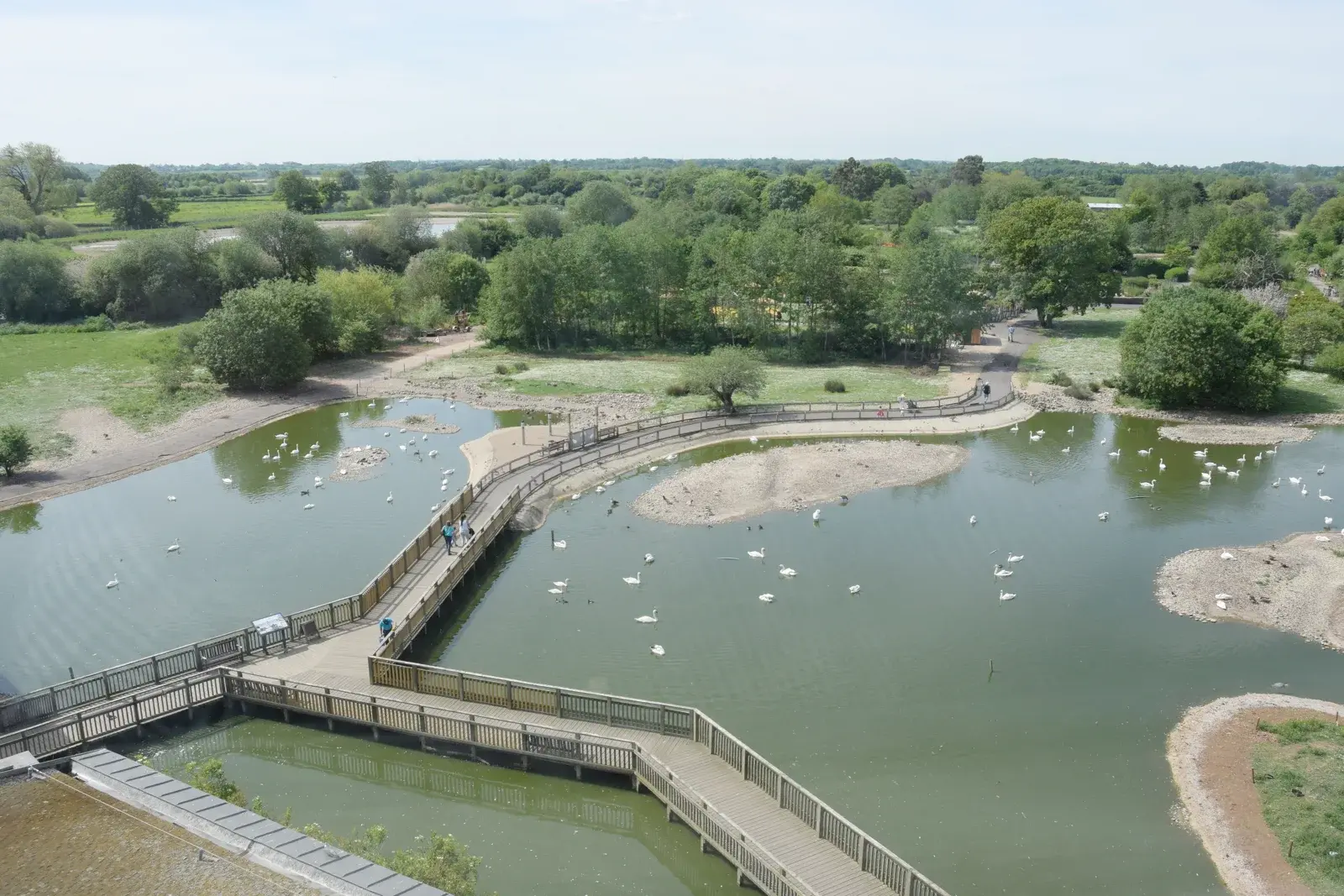
Slimbridge, Gloucestershire, England · GL2 7BT
Winter brings Bewick's Swans, White-fronted Geese and vast duck and wader gatherings; spring and summer add breeding Avocets, cranes, warblers and rich wetland insects.
Decide if the visit fits.
Last checked 9 October 2026.
Opening and charges information · checked .
Stay nearby →Reserve overview
Winter brings Bewick's Swans, White-fronted Geese and vast duck and wader gatherings; spring and summer add breeding Avocets, cranes, warblers and rich wetland insects.
Eight checks for a smoother visit.
Conditions change: check the operator and transport notices before travelling.
January: typically watch Bewick’s Swan from Peng Observatory and White-fronted Goose from Estuary Tower; reserve winter closing controls the end of the day. February: begin with Pintail on the Rushy from Peng Observatory, then compare Wigeon and Teal on the Tack Piece from Robbie Garnett Hide. March: Wigeon and Pintail typically overlap with Avocet; compare Estuary Tower with South Lake Discovery Hide rather than assuming winter swans will stay. April: Avocet and Lapwing are worthwhile from South Lake Discovery Hide and Zeiss Hide. Keep Kingfisher watching within the public hides without searching for its nest. May: give Avocet and Redshank a patient watch from South Lake Discovery Hide and Hogarth Hide. Hobby is a possible addition over the open reserve, not an appointment. June: Crane remains a year-round possibility from Estuary Tower; look for Shoveler and Gadwall on the Rushy and from Kingfisher Hide without approaching breeding birds. July: returning Green Sandpiper can make Martin Smith Hide useful, while Ruff and Black-tailed Godwit warrant a careful South Lake Discovery Hide scan. August: typically compare Ruff and Spotted Redshank on South Lake with Green Sandpiper at the Tack Piece. Cattle Egret is an additional late-summer target from Discovery Hide. September: South Lake Discovery Hide suits Black-tailed Godwit and Spotted Redshank; use the Summer Walkway only while WWT keeps it open for estuary Dunlin and Curlew. October: look for returning White-fronted Goose from Estuary Tower and Teal from Robbie Garnett Hide. In 2026 the last advertised Summer Walkway access is 24 October; it closes from 25 October. November: Bewick’s Swan normally becomes a winter target from Peng Observatory, subject to arrival reports. Estuary Tower offers Golden Plover and Wigeon as well as the wide landscape. December: concentrate on Bewick’s Swan and Pintail from Peng Observatory, then Teal and Water Rail around the Tack Piece from Robbie Garnett Hide. WWT closes on Christmas Day.
Best conditions: Typically a calm, clear interval makes a long estuary scan easier; windy weather favours the sheltered hides. A scope is especially useful for the Dumbles and essential for detailed distant mudflat identification. Light varies between windows, so choose the side with less reflection. The tide affects the estuary, while managed pools may remain productive at other states. These are editorial fieldcraft recommendations.
Use WWT Slimbridge, GL2 7BT, following the brown duck signs. Last admission is one hour before closing. Advance online adult admission, bought before midnight the previous day, is £17.91 without Gift Aid or £19.75 with it; on the day it is £19.90 or £21.90. Advance junior admission for ages 3–17 is £11.84 or £13.05, and on-day admission £13.15 or £14.50. Concession and young-adult prices are listed separately on WWT’s booking page. Under-threes and accompanying carers enter free, as do WWT members. There is no visitor parking charge at WWT Slimbridge. Choose the relevant ticket type rather than confusing the optional Gift Aid price with the basic admission charge.
Access times: Reserve: General admission from 9.30am. April–24 October 2026 closes 5.30pm; 25 October–January 4.30pm; February–March 5pm. Christmas Day closed; Christmas Eve closes 3pm. · Hides: General visitors use hides during centre hours; some seasonal routes and hides close separately. Check the sightings notice for daily restrictions. · Car park: Visitor parking is for a centre visit; independent dawn opening was not verified. Do not plan overnight parking. · Dawn access: no. Operator opening information.
The wild reserve is viewed from a network of hides beyond the collection areas. South Lake provides a useful introduction to ducks and waders; the Rushy and Peng Observatory focus attention on winter wildfowl, while the Estuary Tower gives a broad view towards the Severn and Dumbles. Kingfisher Hide adds another habitat and a winter feeder watch. Choose routes for the wild birds rather than treating every indoor attraction as part of a birding circuit. For a two-hour visit, start at South Lake, then choose the Rushy and Peng area or the Estuary Tower according to the season and current sightings. Leave time to settle at each window. In winter, a long wildfowl watch often adds more than a hurried transfer between several hides; in summer, South Lake’s changing margins can hold the interest. For a full day, combine South Lake and the Rushy with the Estuary Tower, Tack Piece views and a longer walk towards Zeiss and Kingfisher hides. Take a centre break between circuits, then return to a productive hide after the light or birds’ position changes. The seasonal Summer Walkway, when open, adds views from Goose House, the Severn platform and Pillbox; its extension over the seawall towards Mid Point is a different access proposition from the accessible section. These are editorial time plans, not new marked trails. Read the day’s route signs and use WWT’s sightings to choose the most useful wild-reserve stops. Do not assume the Summer Walkway is available year-round.
Use the linked reserve map and directions with current access notices. Species are typical seasonal targets. Light and telescope advice reflects our choice of viewpoint.
Rushy ponds
Indoor observation within centre opening hours.
Winter: Bewick’s Swan, Pintail
Spring: Pintail
Autumn: Bewick’s Swan, Pintail
Light: either. Scope: useful.
Rushy ponds and muddy edges
Winter: Shoveler, Snipe, Great White Egret
Spring: Shoveler, Snipe, Great White Egret
Summer: Shoveler, Great White Egret
Autumn: Shoveler, Snipe, Great White Egret
Light: either. Scope: useful.
Tack Piece pools and wet grassland
Ramp access.
Winter: Teal
Spring: Teal
Summer: Green Sandpiper
Autumn: Teal, Green Sandpiper
Light: either. Scope: useful.
Tack Piece
Lower level accessible.
Winter: Wigeon, Water Rail
Spring: Wigeon, Water Rail
Autumn: Wigeon, Water Rail
Light: either. Scope: useful.
Tack Piece and wet margins
Winter: Wigeon, Teal
Light: either. Scope: useful.
Reed edge and reserve pools
Wheelchair-accessible hide.
Winter: Teal
Light: either. Scope: useful.
Reedbed and adjoining wetland
Lower viewing windows accessible.
Winter: Cetti’s Warbler
Spring: Cetti’s Warbler
Summer: Cetti’s Warbler
Autumn: Cetti’s Warbler
Light: either. Scope: useful.
Dumbles, Tack Piece and Severn Estuary
Lift serves the levels; check service on arrival.
Winter: White-fronted Goose, Crane, Shelduck, Golden Plover, Little Egret, Peregrine
Spring: White-fronted Goose, Crane, Shelduck, Golden Plover, Little Egret, Peregrine
Summer: Crane, Shelduck, Little Egret
Autumn: White-fronted Goose, Crane, Shelduck, Golden Plover, Little Egret, Peregrine
Light: either. Scope: essential.
Tide: Rising water can move estuary birds; lagoons and fields also depend on management.
South Lake wader scrape and deeper lake
Accessible indoor viewing.
Winter: Avocet, Black-tailed Godwit, Pochard, Tufted Duck
Spring: Avocet, Black-tailed Godwit, Pochard, Tufted Duck
Summer: Avocet, Black-tailed Godwit, Tufted Duck, Cattle Egret, Spotted Redshank
Autumn: Avocet, Black-tailed Godwit, Pochard, Tufted Duck, Cattle Egret, Spotted Redshank
Light: either. Scope: useful.
South Lake
Ramp access.
Winter: Redshank
Spring: Redshank
Summer: Redshank
Autumn: Redshank
Light: either. Scope: useful.
Top New Piece and reed edges
Ramp to the lower level.
Winter: Lapwing, Ruff, Marsh Harrier
Spring: Lapwing, Ruff, Marsh Harrier
Summer: Lapwing, Ruff, Marsh Harrier
Autumn: Lapwing, Ruff, Marsh Harrier
Light: either. Scope: useful.
Reedbed and wet grassland
Ramp access.
Winter: Lapwing, Crane
Light: either. Scope: useful.
South Finger pools, ditches and reed margins
Wheelchair accessible; avoid looking for nests.
Winter: Gadwall
Spring: Gadwall, Kingfisher
Summer: Gadwall, Kingfisher
Autumn: Gadwall
Light: either. Scope: useful.
Decoy pool and wooded wetland
Winter: Little Grebe
Spring: Little Grebe
Summer: Little Grebe
Autumn: Little Grebe
Light: either. Scope: useful.
Seawall, Pillbox Pool and estuary
Seasonal access only; confirm opening before walking.
Spring: Hobby
Summer: Hobby
Autumn: Hobby
Light: either. Scope: essential.
Severn mudflats and estuary
Access via the seasonal Summer Walkway, not a winter route.
Spring: Curlew, Dunlin
Summer: Curlew, Dunlin
Autumn: Curlew, Dunlin
Light: either. Scope: essential.
Tide: Use a rising tide within the open route hours; never descend to the mudflats.
| Spot | Overlooks | Key species by season | Best light | Scope | Tide |
|---|---|---|---|---|---|
| Peng ObservatoryIndoor observation within centre opening hours. | Rushy ponds | Winter: Bewick’s Swan, Pintail Spring: Pintail Autumn: Bewick’s Swan, Pintail | either | useful | — |
| Rushy Hide | Rushy ponds and muddy edges | Winter: Shoveler, Snipe, Great White Egret Spring: Shoveler, Snipe, Great White Egret Summer: Shoveler, Great White Egret Autumn: Shoveler, Snipe, Great White Egret | either | useful | — |
| Martin Smith HideRamp access. | Tack Piece pools and wet grassland | Winter: Teal Spring: Teal Summer: Green Sandpiper Autumn: Teal, Green Sandpiper | either | useful | — |
| Robbie Garnett HideLower level accessible. | Tack Piece | Winter: Wigeon, Water Rail Spring: Wigeon, Water Rail Autumn: Wigeon, Water Rail | either | useful | — |
| Stephen Kirk Hide | Tack Piece and wet margins | Winter: Wigeon, Teal | either | useful | — |
| Willow HideWheelchair-accessible hide. | Reed edge and reserve pools | Winter: Teal | either | useful | — |
| Knott HideLower viewing windows accessible. | Reedbed and adjoining wetland | Winter: Cetti’s Warbler Spring: Cetti’s Warbler Summer: Cetti’s Warbler Autumn: Cetti’s Warbler | either | useful | — |
| Estuary TowerLift serves the levels; check service on arrival. | Dumbles, Tack Piece and Severn Estuary | Winter: White-fronted Goose, Crane, Shelduck, Golden Plover, Little Egret, Peregrine Spring: White-fronted Goose, Crane, Shelduck, Golden Plover, Little Egret, Peregrine Summer: Crane, Shelduck, Little Egret Autumn: White-fronted Goose, Crane, Shelduck, Golden Plover, Little Egret, Peregrine | either | essential | Rising water can move estuary birds; lagoons and fields also depend on management. |
| South Lake Discovery HideAccessible indoor viewing. | South Lake wader scrape and deeper lake | Winter: Avocet, Black-tailed Godwit, Pochard, Tufted Duck Spring: Avocet, Black-tailed Godwit, Pochard, Tufted Duck Summer: Avocet, Black-tailed Godwit, Tufted Duck, Cattle Egret, Spotted Redshank Autumn: Avocet, Black-tailed Godwit, Pochard, Tufted Duck, Cattle Egret, Spotted Redshank | either | useful | — |
| Hogarth HideRamp access. | South Lake | Winter: Redshank Spring: Redshank Summer: Redshank Autumn: Redshank | either | useful | — |
| Zeiss HideRamp to the lower level. | Top New Piece and reed edges | Winter: Lapwing, Ruff, Marsh Harrier Spring: Lapwing, Ruff, Marsh Harrier Summer: Lapwing, Ruff, Marsh Harrier Autumn: Lapwing, Ruff, Marsh Harrier | either | useful | — |
| Van de Bovenkamp HideRamp access. | Reedbed and wet grassland | Winter: Lapwing, Crane | either | useful | — |
| Kingfisher HideWheelchair accessible; avoid looking for nests. | South Finger pools, ditches and reed margins | Winter: Gadwall Spring: Gadwall, Kingfisher Summer: Gadwall, Kingfisher Autumn: Gadwall | either | useful | — |
| Decoy Hide | Decoy pool and wooded wetland | Winter: Little Grebe Spring: Little Grebe Summer: Little Grebe Autumn: Little Grebe | either | useful | — |
| Summer Walkway viewing platformSeasonal access only; confirm opening before walking. | Seawall, Pillbox Pool and estuary | Spring: Hobby Summer: Hobby Autumn: Hobby | either | essential | — |
| Middle PointAccess via the seasonal Summer Walkway, not a winter route. | Severn mudflats and estuary | Spring: Curlew, Dunlin Summer: Curlew, Dunlin Autumn: Curlew, Dunlin | either | essential | Use a rising tide within the open route hours; never descend to the mudflats. |
Month chips show typical presence or our preferred viewing season. Choose birds that suit the time of your visit.
Use rising water for the estuary and compare it with the managed lakes. Ask the wardens about that day’s tide and route closures; do not leave the marked paths.
Main visitor paths are level and hard surfaced, with accessible parking, toilets and a Changing Places facility. WWT offers manual wheelchairs and mobility scooters; the published scooter charge is £15 for the day with a £25 deposit, booked at least a day ahead through the centre. Ground access does not mean a scooter should be taken into every hide: WWT advises keeping scooters outside hides. The Estuary Tower has a lift to its levels. South Lake Discovery, Willow and Kingfisher are among the useful viewing options, while lower viewing positions or ramps are provided at several other hides, including Zeiss, Martin Smith and Van de Bovenkamp. Pick a specific route and viewpoint rather than assuming every window has the same height or turning space. Hearing loops, large-print information and sensory resources are available. Accommodation has separate access details. Bewick’s Lodge in Scott House has an entrance step and fourteen stairs to the bedrooms, with no lift; it is not a step-free substitute for a day visit. Warblers’ Meadow includes the Reed Warbler hut with a ramp and wider entrance. Establish the suitable accommodation directly with WWT before booking a stay that depends on those features.
The visitor complex provides the Kingfisher Kitchen, toilets, a shop, picnic options and family facilities. Bring water for a long hide circuit, where a café is not beside every viewpoint. Bicycle parking and electric-vehicle charging are available at the arrival area. The nature reserve and collection areas offer different experiences, so leave time to move between the visitor hub and wild-reserve hides. On-site self-catering accommodation is a separate WWT booking, described in the stay section below.
Pet dogs are not permitted at Slimbridge and must not be left in cars while visitors enter. Trained assistance dogs are welcome on a lead and under control; leave an area if wildlife is disturbed. Check the relevant accommodation’s rules separately when planning an overnight stay.
Cam & Dursley station is on the Bristol–Gloucester railway line, about 3.4 miles from the centre. The bookable Robin service in the Berkeley Vale zone can provide the final connection, but it is demand responsive rather than a bus to wait for without a reservation. Arrange both legs through its booking service; the council describes operation Monday–Saturday, with specified holiday exclusions. Stagecoach route 65 links Gloucester and Dursley and stops on the A38 near the Slimbridge village approach. WWT describes a further 2.1-mile walk to the centre, including a final lane section with limited pedestrian separation. A bus to the village is therefore not a reserve-door arrival. A pre-booked taxi from the railway station is useful if the walking route or Robin availability is unsuitable. Cyclists have the National Cycle Network 41 connection. Drivers use M5 junctions 13 or 14 and the brown duck signs. The stay measurements below use the main car park as their endpoint; WWT’s on-site accommodation requires no road transfer to the centre.
Useful bases for an early start.
Booking.com links are affiliate links: we may earn a commission at no extra cost to you. How these links work.
Bewick’s Lodge is in Scott House; Warblers’ Meadow provides separate WWT shepherd huts. Both are on-site, with 0 miles and 0 minutes of road transfer to the centre.
Official on-site accommodation · 2026-10-09. No road transfer is needed.
Best for staying beside the wetlands with WWT centre access during opening hours. Book directly with WWT; Bewick’s Lodge has stairs, while Reed Warbler hut has step-free access.Book this accommodation with its operatorAbout 1.3 miles by road, roughly 5 minutes’ drive from Slimbridge to the visitor arrival point. Allow extra time around Slimbridge for traffic.
Measured driving route · 2026-10-09. Map estimates exclude live traffic.
Choose Slimbridge for practical inns, self-catering and public-transport connections.Find places to stay in Slimbridge on Booking.comAbout 5.4 miles by road, roughly 15 minutes’ drive from Dursley to the visitor arrival point. Allow extra time around Dursley for traffic.
Measured driving route · 2026-10-09. Map estimates exclude live traffic.
Choose Dursley for practical inns, self-catering and public-transport connections.Find places to stay in Dursley on Booking.comAbout 3.5 miles by road, roughly 10 minutes’ drive from Cam to the visitor arrival point. Allow extra time around Cam for traffic.
Measured driving route · 2026-10-09. Map estimates exclude live traffic.
Choose Cam for practical inns, self-catering and public-transport connections.Find places to stay in Cam on Booking.comAbout 14.3 miles by road, roughly 25 minutes’ drive from Gloucester to the visitor arrival point. Allow extra time around Gloucester for traffic.
Measured driving route · 2026-10-09. Map estimates exclude live traffic.
Choose Gloucester for a city base with a wider range of hotels and a longer Severn trip.Find places to stay in Gloucester on Booking.comAbout 25.7 miles by road, roughly 40 minutes’ drive from Bristol to the visitor arrival point. Allow extra time around Bristol for traffic.
Measured driving route · 2026-10-09. Map estimates exclude live traffic.
Choose Bristol for a city base with a wider range of hotels and a longer Severn trip.Find places to stay in Bristol on Booking.comExplore Gloucestershire’s full guides and smaller birding sites
Contact 01453 891900 or info.slimbridge@wwt.org.uk for visitor enquiries, access and mobility equipment. For overnight stays, use slimbridge.accommodation@wwt.org.uk and WWT’s own booking controls for Bewick’s Lodge in Scott House or Warblers’ Meadow. WWT publishes dated latest sightings and a Rushy webcam; those are the useful current wildlife sources without copying a report into permanent seasonal guidance. The booking, access and directions links below support the practical arrangements.
Check WWT Slimbridge latest wildlife sightings. weekly Reports show what has been seen, not what will be.
Follow the BTO Birders’ Code and give wildlife space.
WWT Slimbridge: Adult £17.91 advance/£19.90 on day without Gift Aid; WWT members free; parking free.
WWT Slimbridge: Pet dogs are not permitted at Slimbridge and must not be left in cars while visitors enter.
WWT Slimbridge: Winter swans · rewarding year-round.
WWT Slimbridge: Main visitor paths are level and hard surfaced, with accessible parking, toilets and a Changing Places facility.
WWT Slimbridge: Cam & Dursley station is on the Bristol–Gloucester railway line, about 3.4 miles from the centre.
Shorter stops within 15 miles in a straight line. Use the operator’s arrival directions for the journey.
Cannop Ponds car park approach, Forest of Dean · Marsh, meandering streams, alder and birch woodland
Churcham · Ancient woodland
Near Birdlip, between Gloucester and Cheltenham · Limestone grassland, scrub and semi-natural beech woodland
Nearby complete guides.
Stops with a purpose: use one as a contrasting habitat or weather-proof Plan B. Distances are straight-line estimates, not road journeys.