
Short entry3.4 miles away
Marloes Mere
Marloes Peninsula · Freshwater wetland, reedbed and surrounding scrub
 the ai birderBirding near me
The AI Birder · one-page field sheet
Pembrokeshire, Wales · boat departure SA62 3BJ · SA62 3BJ

Chough · Gannet · Cormorant · Chiffchaff · Goldcrest · Teal
North Haven (landing and public path) · The Wick (marked viewing path) · High Cliff (marked viewing path) · Garland Stone (public coastal path) · Skomer Head (public path) · North Pond Public Hide · The Farm (public paths and visitor area) · North Valley Crossing (public path) · South Stream (public path)
Check current access, hide closures and operator notices before travelling. Seasonal birds are possibilities, not promised sightings. Keep to authorised routes and give wildlife space.
Opening and charges checked 2026-10-25. Operator: https://www.welshwildlife.org/visit/skomer-island
Full guide and current source links: https://aibirder.co.uk/reserves/skomer-island
WA 01 · Wildlife Trust of South and West Wales reserve guide
Pembrokeshire, Wales · boat departure SA62 3BJ
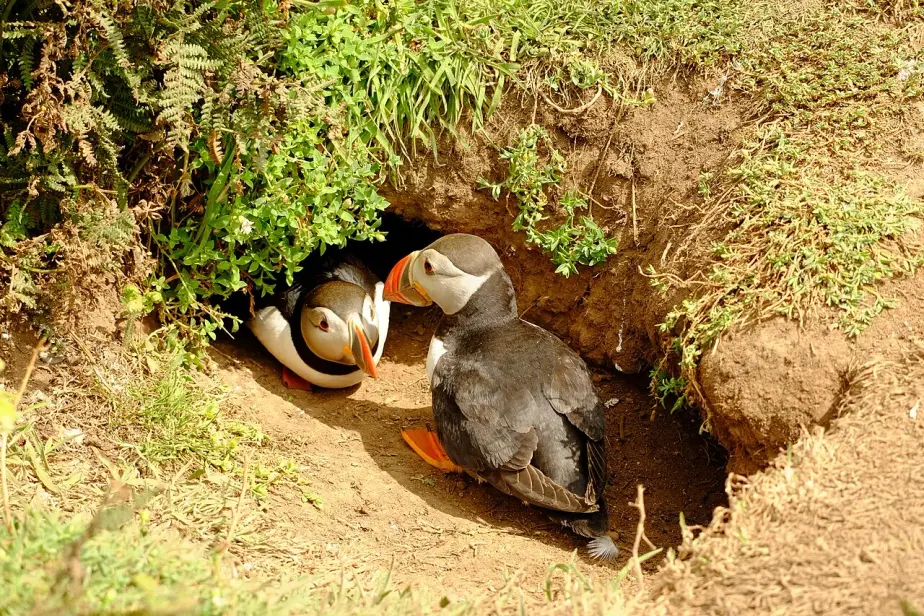
Puffins near burrows, crowded auk ledges and Manx Shearwaters at sea make Skomer a special Pembrokeshire island visit.
Decide if the visit fits.
Last checked 18 October 2026.
Opening and charges information · checked .
Stay nearby →Reserve overview
Puffins near burrows, crowded auk ledges and Manx Shearwaters at sea make Skomer a special Pembrokeshire island visit.
Eight checks for a smoother visit.
Conditions change: check the operator and transport notices before travelling.
January: Skomer has no ordinary day landings. Chough is a year-round island species, but The Wick and the island’s other viewpoints are outside a routine winter visitor itinerary. Use this month to select a spring sailing; read the operator reports without following staff-only winter routes.
February: public day landings remain outside the published programme. The operator’s wider island year can include returning birds, but North Haven is not a walk-in mainland viewpoint. Plan April for Guillemots and Razorbills there instead of assuming a February landing can be arranged.
March: Guillemots and Razorbills typically gather at North Haven while Chiffchaffs and Goldcrests can pass through North Valley Crossing. These are island ecological changes; the ordinary visitor programme starts in April. Do not treat a staff March report as permission to land early.
April: usually begin the booked island visit at North Haven for Guillemots and Razorbills, then follow the permitted path to The Wick for returning Puffins. The Wildlife Trust’s visitor timeline favours mid-April onwards for Puffins. Leave time for North Pond Public Hide and its Shelduck and Shoveler.
May: typically give The Wick a sustained Puffin watch and compare the Kittiwakes at High Cliff. The Farm’s public paths add Wheatear, Swallow and Meadow Pipit. Stay on the marked line throughout: apparently empty turf can conceal burrows, and a feeding bird needs room to pass.
June: usually choose the main seabird circuit for Puffins at The Wick and Guillemots and Razorbills at North Haven. Kittiwakes also use the South Stream coastal view. On the northern circuit, Garland Stone offers Gannets and Shags; binoculars are usually easier than a tripod on a busy path.
July: typically visit early in the month for Puffins at The Wick and auks at North Haven. The operator says auk departures begin during July and Puffins have gone by its end. North Pond Public Hide offers Mallard, Moorhen and Shoveler as the cliff colonies change.
August: usually switch from Puffins to Manx Shearwaters offshore from Skomer Head, gulls around the coastal circuit and passage birds near The Farm and North Valley Crossing. A scope can help with the offshore watch. Night-time shearwater activity requires an authorised overnight stay or operator event.
September: typically combine Willow Warblers and Chiffchaffs along the North Valley Crossing route with Teal from North Pond Public Hide. Skomer Head can offer Common Scoters and Manx Shearwaters offshore. The day-boat schedule is reduced, so the confirmed return sailing determines the length of the circuit.
October: ordinary day landings have ended. Staff reports can describe Common Scoters from Skomer Head and Goldcrests at North Valley Crossing, but those reports do not extend visitor access. Keep the island watching places for a booked open-season trip and choose a safe mainland alternative now.
November: no ordinary island day trip is available. Late migrants such as Goldcrest and Chiffchaff can be part of the island reports, with North Valley Crossing a recording area rather than an accessible winter outing. Review the next year’s official programme before making travel commitments.
December: the public island circuit remains outside its season. Choughs are year-round island birds, while the visitor decision is when to return to The Wick for the summer seabirds. Match any new booking to the operator’s published year and keep flexibility for weather cancellations.
Best conditions: Typically choose settled weather and good visibility for the longer cliff circuit; a boat cancellation can prevent landing even when the mainland looks calm. Wind and spray can make Skomer Head uncomfortable for a scope, while North Haven and an inland path may offer a more useful short watch. The sailing fixes a day visitor’s hours. Night-time Manx Shearwater experiences belong to authorised overnight stays or operator events. Light ratings are editorial: change the window or path-facing direction as the sun moves, without leaving the permitted route.
Pembrokeshire Islands Boat Trips is the only commercial boat operator that lands day visitors, as confirmed by the Wildlife Trust. Its landing ticket combines the crossing and island admission; use the dated fares in Boat access. The boat company requires check-in at Lockley Lodge, Martin’s Haven, one hour before departure. A cruise ticket is a different product and does not give island access. The National Trust manages mainland parking. The Wildlife Trust’s day-trip page checked on 18 October 2026 contains conflicting £8 and £7 daily tariffs; consult the National Trust’s current Martin’s Haven information and the displayed tariff before paying. National Trust members are described as parking free. Allow time for payment and the walk to the departure point. The published day-visitor limit is 250, reported by Visit Pembrokeshire and the boat operator’s Visit Wales listing; reserve a place rather than relying on a walk-up ticket.
Access times: Reserve: Public day landings in the published 2026 programme: April–August Tuesday–Sunday; reduced September operation, with no Friday day boats in September. · Hides: Public hide and marked viewpoints during the time ashore allocated to your booked landing; research areas remain restricted. · Car park: Martin’s Haven is a separate National Trust mainland car park; use its current parking conditions and allow the required boat check-in time. · Dawn access: no. Operator opening information.
The Pembrokeshire Coast National Park describes a four-mile island walk taking about three hours. That is a walking estimate, not a promise that you can stop at every colony and still finish comfortably. Use the welcome briefing and current visitor map to choose between the signed branches. North Haven, the Wick, the Farm and the Garland Stone area help you orientate the day without treating every viewpoint as compulsory. Our suggested two-hour plan is a focused period within your booked landing visit, not a shorter boat ticket. Begin by getting your bearings at North Haven, follow the signed route towards the Wick if open, and give one colony viewpoint a proper watch. Compare Puffins arriving and departing with the more tightly packed auk ledges. Turn back with generous time for the walk to your allocated return. Add a Farm stop only when it fits that route and your pace. For a full-day plan, keep the whole visit within the sailing arrangement. After the briefing, select a longer marked circuit with time around the Wick and a second coastal viewpoint towards the Garland Stone if the current map and conditions permit. Take a picnic break, then retrace the return connection before you become tired. Spend spare time watching flight lines rather than adding an improvised detour. These are editorial itineraries, adjustable to weather, closures and the time available; the birding reward comes from patient observation, not completing a checklist of headlands.
Use the linked reserve map and directions with current access notices. Species are typical seasonal targets. Light and telescope advice reflects our choice of viewpoint.
Sheltered water, auk ledges and the cliff above the landing
Landing climb and public path only; leave the steps and bird flight lines unobstructed.
Spring: Puffin, Guillemot, Razorbill
Summer: Puffin, Guillemot, Razorbill
Autumn: Shag, Rock Pipit
Light: either. Scope: useful.
Cliff ledges, coastal water and the permitted clifftop Puffin view
Stay on the marked route; limit stationary time so other visitors and birds can pass.
Spring: Puffin, Kittiwake, Fulmar
Summer: Puffin, Kittiwake, Chough
Autumn: Fulmar, Chough
Light: either. Scope: not needed.
South-coast cliffs and auk and Kittiwake ledges
Unfenced cliff-side walking; follow the briefing and any temporary cordons.
Spring: Guillemot, Razorbill, Kittiwake
Summer: Guillemot, Razorbill, Kittiwake
Autumn: Herring Gull, Great Black-backed Gull
Light: either. Scope: useful.
Northern rocks and offshore water
The viewing position is the public island path; do not scramble onto offshore rocks.
Spring: Gannet, Shag, Chough
Summer: Gannet, Shag, Chough
Autumn: Common Scoter, Cormorant
Light: either. Scope: useful.
Open sea west of the island
Use a stable position back from the cliff edge; shorten this exposed leg in strong wind.
Spring: Gannet, Manx Shearwater
Summer: Gannet, Manx Shearwater
Autumn: Manx Shearwater, Common Scoter, Cormorant
Light: either. Scope: essential.
Freshwater pond and the margins visible from the visitor hide
Use the public hide only; the separate research hide is outside this visitor recommendation.
Spring: Shelduck, Shoveler, Mallard
Summer: Mallard, Moorhen, Shoveler
Autumn: Teal, Shoveler
Light: either. Scope: useful.
Central grassland and the buildings’ public surroundings
Keep to visitor paths; accommodation and research rooms are not public birding hides.
Spring: Wheatear, Meadow Pipit, Pied Wagtail, Swallow
Summer: Swallow, Dunnock, Meadow Pipit
Autumn: Swallow, Willow Warbler, Wheatear
Light: either. Scope: not needed.
Sheltered scrub and the valley’s permitted path edges
Listen from the path; never enter the scrub or use playback.
Spring: Sedge Warbler, Chiffchaff, Willow Warbler
Summer: Whitethroat, Sedge Warbler
Autumn: Goldcrest, Chiffchaff, Willow Warbler
Light: either. Scope: not needed.
Valley grassland, stream edge and the coastal view
Use only the signed public route; the shoreline and valley margins are not shortcuts.
Spring: Meadow Pipit, Wheatear
Summer: Kittiwake, Meadow Pipit
Autumn: Rock Pipit, Wheatear
Light: either. Scope: useful.
| Spot | Overlooks | Key species by season | Best light | Scope | Tide |
|---|---|---|---|---|---|
| North Haven (landing and public path)Landing climb and public path only; leave the steps and bird flight lines unobstructed. | Sheltered water, auk ledges and the cliff above the landing | Spring: Puffin, Guillemot, Razorbill Summer: Puffin, Guillemot, Razorbill Autumn: Shag, Rock Pipit | either | useful | — |
| The Wick (marked viewing path)Stay on the marked route; limit stationary time so other visitors and birds can pass. | Cliff ledges, coastal water and the permitted clifftop Puffin view | Spring: Puffin, Kittiwake, Fulmar Summer: Puffin, Kittiwake, Chough Autumn: Fulmar, Chough | either | not needed | — |
| High Cliff (marked viewing path)Unfenced cliff-side walking; follow the briefing and any temporary cordons. | South-coast cliffs and auk and Kittiwake ledges | Spring: Guillemot, Razorbill, Kittiwake Summer: Guillemot, Razorbill, Kittiwake Autumn: Herring Gull, Great Black-backed Gull | either | useful | — |
| Garland Stone (public coastal path)The viewing position is the public island path; do not scramble onto offshore rocks. | Northern rocks and offshore water | Spring: Gannet, Shag, Chough Summer: Gannet, Shag, Chough Autumn: Common Scoter, Cormorant | either | useful | — |
| Skomer Head (public path)Use a stable position back from the cliff edge; shorten this exposed leg in strong wind. | Open sea west of the island | Spring: Gannet, Manx Shearwater Summer: Gannet, Manx Shearwater Autumn: Manx Shearwater, Common Scoter, Cormorant | either | essential | — |
| North Pond Public HideUse the public hide only; the separate research hide is outside this visitor recommendation. | Freshwater pond and the margins visible from the visitor hide | Spring: Shelduck, Shoveler, Mallard Summer: Mallard, Moorhen, Shoveler Autumn: Teal, Shoveler | either | useful | — |
| The Farm (public paths and visitor area)Keep to visitor paths; accommodation and research rooms are not public birding hides. | Central grassland and the buildings’ public surroundings | Spring: Wheatear, Meadow Pipit, Pied Wagtail, Swallow Summer: Swallow, Dunnock, Meadow Pipit Autumn: Swallow, Willow Warbler, Wheatear | either | not needed | — |
| North Valley Crossing (public path)Listen from the path; never enter the scrub or use playback. | Sheltered scrub and the valley’s permitted path edges | Spring: Sedge Warbler, Chiffchaff, Willow Warbler Summer: Whitethroat, Sedge Warbler Autumn: Goldcrest, Chiffchaff, Willow Warbler | either | not needed | — |
| South Stream (public path)Use only the signed public route; the shoreline and valley margins are not shortcuts. | Valley grassland, stream edge and the coastal view | Spring: Meadow Pipit, Wheatear Summer: Kittiwake, Meadow Pipit Autumn: Rock Pipit, Wheatear | either | useful | — |
Month chips show typical presence or our preferred viewing season. Choose birds that suit the time of your visit.
Boat and landing access are controlled by the skipper and the booked sailing, not a self-selected tide height. The public island paths remain above the shore; never descend towards a colony or attempt a crossing through Jack Sound. Consult Skomer predictions for marine context and the operator for whether a trip can run.
Operator: Pembrokeshire Islands Boat Trips.
Booking opens: 2027 day trips go on sale in December 2026, confirmed by the Wildlife Trust; an exact day is not yet announced. Season: The published 2026 timetable covers April–August, with a reduced September service; closed days: Mondays except the advertised Whitsun bank-holiday sailing; September Fridays also have no day boats. Do not assume the 2026 exception fixes the 2027 calendar. Fares: 2026 boat-and-landing ticket: adult (12+) £42 on 1–15 April, £46 on 16 April–31 July, £32 on 1 August–30 September; child (2–11) £30, £30 and £24 respectively. Infants travel free on an adult’s lap.
Time ashore: The boat company describes approximately 4½ hours ashore within a five-hour trip. Keep the return departure allocated to your booking. Landing access: North Haven landing; read Accessibility before booking a landing rather than a round-island cruise. Weather policy: Adverse sea conditions can cancel sailings. The Wildlife Trust says cancellation emails trigger automatic full refunds; retain flexibility in mainland accommodation
The Wildlife Trust’s accessibility page confirms 87 steps after landing, narrow island paths and some steep, rough sections. It says wheelchair users cannot make the island visit and that day visitors cannot receive a vehicle lift to the Farm. Martin’s Haven jetty is also described as steep. Consider the combined demands of boarding, the climb and a return walk before buying a landing ticket; being able to manage one flight of steps at home does not establish suitability for the whole visit. Staff can adjust the welcome talk for people who need longer to climb, including giving a separate briefing. Printed welcome information and a hearing-loop system are available. Blind and partially sighted visitors can arrange a staff chaperone in advance with the Visitor Officer; assistance-animal rules are in Dogs below. Discuss the specific support you need before booking travel. A non-landing boat trip can be an alternative. The Trust describes accessible sailings from Dale jetty for wheelchair users and people with limited mobility, but these are separately arranged trips. Establish availability, boarding arrangements and suitability with the operator before choosing one; a standard Martin’s Haven cruise should not be assumed to have the same access.
Bring a complete picnic and enough drinking water: the Wildlife Trust lists no island café or shop and cannot refill bottles from a mainland water supply. Compost toilets are at the Farm in the centre of the island. Plan your walking choice around that location rather than expecting a toilet beside each colony. There are no rubbish bins, so carry everything back, including food scraps. Pack possessions in securely closed bags to meet island biosecurity rules.
Dogs are not permitted on Skomer, including assistance dogs, under the Wildlife Trust’s island rules. Arrange suitable care on the mainland before the crossing. A mainland coastal walk or a boat product with its own explicitly confirmed dog policy is a different outing; a pet-friendly cruise does not grant permission to land.
Martin’s Haven is the departure point; the sailing company’s Neyland address is not the boarding location. Haverfordwest and Milford Haven are the rail gateways identified by the Wildlife Trust. From either, arrange the final journey in advance and match it to the earlier check-in requirement, not simply the boat’s departure. Save the return connection as well as the outward journey. Richards Bros publishes the seasonal Puffin Shuttle 400 between St Davids and Martin’s Haven for 23 May–27 September 2026. That timetable is evidence for 2026, not a 2027 service promise. Before booking a 2027 trip, use the operator’s new timetable or arrange a taxi connection from the station. The Wildlife Trust also points to Transport for Wales fflecsi services in the area; book and confirm the actual pickup and arrival time rather than assuming an on-demand bus is waiting at the station. A missed last connection can make an otherwise short island outing difficult.
Useful bases for an early start.
Booking.com links are affiliate links: we may earn a commission at no extra cost to you. How these links work.
About 2.2 miles by road, roughly 3.8 minutes’ drive from Marloes OS Open Names settlement centre to Martins Haven locality at access road / car-park approach. OSRM / OpenStreetMap estimate measured 18 October 2026, excluding traffic, parking and check-in.
Measured driving route · 2026-10-18. Map estimates exclude live traffic.
A short mainland transferFind places to stay in Marloes on Booking.comAbout 28.8 miles by road, roughly 52.5 minutes’ drive from St Davids OS Open Names settlement centre to Martins Haven locality at access road / car-park approach. OSRM / OpenStreetMap estimate measured 18 October 2026, excluding traffic, parking and check-in.
Measured driving route · 2026-10-18. Map estimates exclude live traffic.
A wider Pembrokeshire coastal holidayFind places to stay in St Davids on Booking.comAbout 14.3 miles by road, roughly 28.5 minutes’ drive from Haverfordwest OS Open Names settlement centre to Martins Haven locality at access road / car-park approach. OSRM / OpenStreetMap estimate measured 18 October 2026, excluding traffic, parking and check-in.
Measured driving route · 2026-10-18. Map estimates exclude live traffic.
Rail connections and an arranged final transferFind places to stay in Haverfordwest on Booking.comExplore Pembrokeshire’s full guides and smaller birding sites
Use the Wildlife Trust’s Skomer visitor pages for island arrangements and Pembrokeshire Islands Boat Trips for the sailing booking. The Skomer Visitor Officer’s published email is skomer.vo@welshwildlife.org; explain any requested adjustment before paying for travel. The boat operator publishes 01646 603123 for trip enquiries. Check the official island team’s updates for the character of recent wildlife activity, while keeping your itinerary based on the season and the sailing you have actually booked.
Check Skomer island team: recent sightings. frequent in season; dated entries are collected on one page Reports show what has been seen, not what will be.
Follow the BTO Birders’ Code and give wildlife space.
Skomer Island: 2026 combined boat/landing adult £32–£46 by season, child £24–£30; mainland parking separate.
Skomer Island: Dogs are not permitted on Skomer, including assistance dogs, under the Wildlife Trust’s island rules.
Skomer Island: Typically mid-April–July for Puffins; spring and summer seabirds.
Skomer Island: It says wheelchair users cannot make the island visit and that day visitors cannot receive a vehicle lift to the Farm.
Skomer Island: Martin’s Haven is the departure point; the sailing company’s Neyland address is not the boarding location.
Shorter stops within 15 miles in a straight line. Use the operator’s arrival directions for the journey.
Marloes Peninsula · Freshwater wetland, reedbed and surrounding scrub
Nearby complete guides.
Stops with a purpose: use one as a contrasting habitat or weather-proof Plan B. Distances are straight-line estimates, not road journeys.