Bempton
Best for early colony visits and village B&Bs or cottages.
Find stays in Bempton on Booking.com the ai birderBirding near me
Responsible wildlife guide
Choose Bempton for spring and summer Gannets from mainland platforms, Bass Rock for a booked boat experience, or Troup Head for a more exposed mainland coastal walk.
Watch gannets from coastal viewpoints or a responsible boat trip, comparing Bass Rock, Bempton, Troup Head and Grassholm for a spring or summer visit.
NearestBase is a relevant existing-guide base for the stated arrival, not a new accommodation inspection or an independently ranked distance comparison.
| Place | Season | Access and booking | Nearby base |
|---|---|---|---|
| RSPB Bempton Cliffs | Spring–summer seabird season; operator describes March–August gathering. | Public clifftop viewing platforms, with level options described by the operator. Official visit/booking instructions | Bempton |
| Bass Rock and Scottish Seabird Centre | Spring–summer; general boat programme late March–early October, catamaran April–September. | Booked North Berwick cruise; a guided landing is a separate restricted product. Official visit/booking instructions | North Berwick |
| RSPB Troup Head | Spring–summer colony watching; existing target window March–September. | Public coastal approach with slopes, narrow gates, steps and exposed cliffs. Official visit/booking instructions | Gardenstown |
Choose the exact Bass Rock product before booking; a cruise remains afloat and does not grant landing access. No 2027 release date is invented.
Troup’s page retains a 9–12 May road notice without a year in the notice text. Do not label that past-month notice an active October closure; check current road advice.
Stay behind public viewpoint boundaries and obey the boat guide. Never descend from a cliff path to improve a colony view.
Some links earn us a small commission at no extra cost to you. These are settlement search bases, with no promise of availability.
Best for early colony visits and village B&Bs or cottages.
Find stays in Bempton on Booking.comKeeping your departure morning local and spending time on the harbour shoreline.
Find stays in North Berwick on Booking.comA nearby coastal village for flexible colony visits.
Find stays in Gardenstown on Booking.comA town base with the current route 273 connection towards Gardenstown.
Find stays in Banff on Booking.com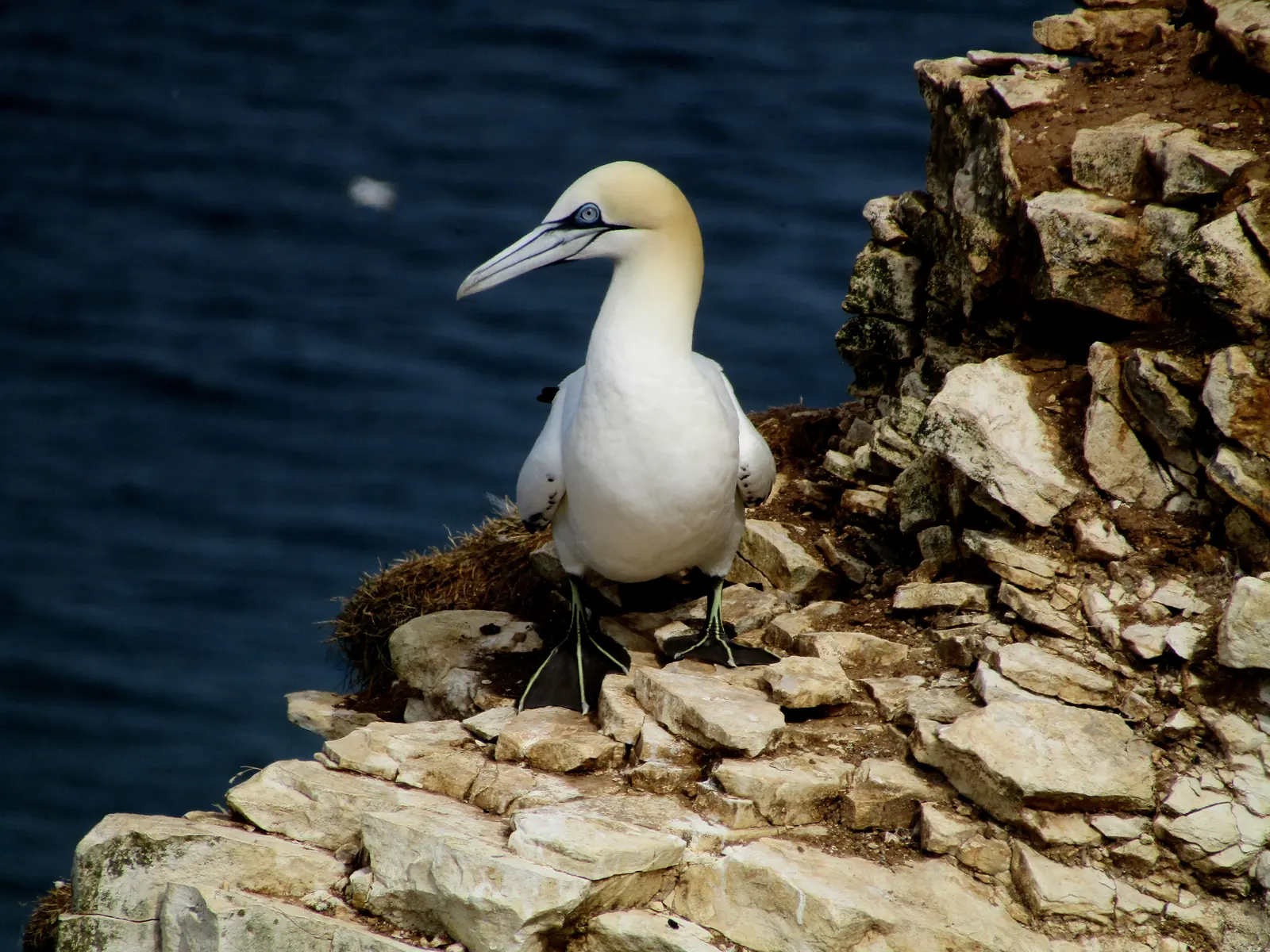
Adult Northern Gannets are large, white seabirds with black wingtips, long pointed wings, a pointed tail and a substantial pale bill. At sea, look for a sequence of wingbeats followed by a glide. Feeding birds may rise, circle and plunge into the water, providing a very different view from the rows of resting adults at a colony. Begin with that overall shape before trying to identify every distant bird.
A colony visit is especially useful for comparing birds in flight with birds settled on the breeding ledges. A sea watch adds travelling and feeding behaviour. Neither requires an unusually close approach: binoculars show the repeated movements of arriving adults, while a telescope helps examine a distant ledge from an established viewpoint. Keep equipment behind barriers and put it away before moving over awkward ground.
Spring and summer usually provide the clearest reason to travel to a breeding colony. Adults typically return, occupy nesting places and spend the season raising young, with attendance changing as the cycle progresses. The RSPB describes Bempton’s wider seabird season as March–August and highlights April–July for its busiest colony experience. That is a useful planning window rather than a promise about a particular day.
A land-based reserve and an offshore trip have different weather limits. A cliff watch can often be shortened or followed by a sheltered break, while a boat journey depends on a sailing being safe and suitable. Keep flexibility in an overnight itinerary and choose a trip whose boarding arrangements and conditions suit everyone travelling. Check the actual operator’s information before making the journey, including any current access or wildlife restrictions.
The Scottish Seabird Centre’s Bass Rock trips leave North Berwick Harbour. Its Three Islands Seabird Seafari is a RIB cruise around the Lamb, Craigleith and Bass Rock, offering an offshore perspective on the gannets. The published general season is Easter to autumn, subject to conditions. Choose the specific product when booking: a cruise around an island and a landing experience are separate arrangements.
The Bass Rock and Scottish Seabird Centre guide below sets out the available trip types and mainland approach. For birdwatching, leave time to follow a small sequence: an adult travelling past the boat, another joining the colony and birds circling above the water. It is easier to appreciate those patterns than to photograph every bird in a continuous rush. Follow the skipper’s position and movement instructions.
RSPB Bempton Cliffs offers a mainland Yorkshire colony visit from managed clifftop viewpoints. It suits visitors who prefer to remain on land and spend as long as they choose comparing neighbouring ledges. The reserve guide below explains the route, facilities and access options. Give other visitors a turn at the clearest view and resist leaning beyond a barrier for a different photograph.
RSPB Troup Head in Aberdeenshire is described by the RSPB as Scotland’s largest mainland Gannet colony. Its paths include uneven ground, narrow sections and steps, and the reserve has no toilets. Use the official Troup Head reserve page in the sources below for the current approach and access details. This is a separate destination from Bempton, so select it for the journey and walking conditions you can manage rather than assuming all mainland colonies provide similar facilities.
Thousand Islands Expeditions advertises a Grassholm Seabird Spectacular from St Justinians near St Davids. Its 2026 information describes a three-hour offshore trip, normally operating from May to mid-September, with a minimum age of eight. The boat travels out to view the gannet colony; there is no public landing on Grassholm. The operator’s listing varies between “multiple times per week” and “daily”, so select an actual available sailing rather than relying on a general frequency claim.
The Ramsey Island guide below provides context for the same mainland departure area, but its landing ticket is a different product and does not include Grassholm. Use the Grassholm operator link for that offshore trip. Pack for time at sea, secure loose belongings and leave the route and approach to the crew. Dolphins, seals or other seabirds can add interest, but the trip should be chosen for its advertised itinerary, without expecting every possible species to appear.
A busy Gannet colony can make it surprisingly difficult to decide where to look. Our choice is to select a modest piece of the legitimate public view and follow a few birds through it, rather than continually trying to take in everything. Watch one adult arrive or depart, then compare another using the same broad area. You may begin to recognise the difference between a bird travelling past and one joining the activity, without needing a closer position or access to the colony itself.
On a boat, allow the crew's route and stopping decisions to organise the session. Find a stable stance and keep a broad view available between photographs. A tightly framed image can lose the relationship between the bird, sea and colony that makes the trip distinctive. On land, a fixed public viewpoint allows a more leisurely comparison, though glare and distance will still limit some details. Neither experience needs to produce an uninterrupted series of dramatic dives to justify the day.
After a short period, change the question rather than necessarily changing place. Compare birds in flight with birds already settled, or look at the sequence of wingbeats and gliding described in the RSPB account. Record only the behaviour you actually observe. If feeding activity remains elsewhere, that is a feature of your visit, not a fault to correct by asking for a closer approach. This method gives a very busy scene enough structure to remember, while respecting the separation between ordinary visitor watching and the birds' occupied habitat.
These rows use existing reserve watching-place records and typical local seasons. Sensitive locations are withheld. Follow current operator restrictions.
| Reserve and public watching place | Typical months | Best light | Scope |
|---|---|---|---|
| Bass Rock and Scottish Seabird Centre: Bass Rock (guided boat circuit) | February, March, April, May, June, July, August, September, October | either | not needed |
| Skomer Island: Skomer Head (public path) | March, April, May, June, July, August, September, October | either | essential |
| RSPB Bempton Cliffs: Staple Newk | February, March, April, May, June, July, August, September | either | useful |
| RSPB Rathlin Island: West Light main viewing platform | April, May, June, July, August, September | either | useful |
| RSPB South Stack: World War II Lookout | March, April, May, June, July, August, September, October | morning | essential |
| RSPB Fowlsheugh: Stone shelter at the trail end | April, May, June, July, August, September, October | either | essential |
| Spurn National Nature Reserve: Public Seawatch Hide | March, April, May, June, July, August, September, October | either | essential |
| Mull of Galloway: Public high-point sea views around the reserve | March, April, May, June, July, August, September, October | either | essential |
| Portland Bird Observatory and Portland Bill: Bill tip public seawatching ground | January, February, March, April, May, June, July, August, September, October, November, December | either | essential |
| Flamborough Head and Flamborough Bird Observatory: Seawatch Observatory | March, April, May, June, July, August, September, October | either | essential |
| RSPB Troup Head: Headland section of the clifftop path | March, April, May, June, July, August, September | either | useful |
| St Abbs Head National Nature Reserve: Lighthouse Loop public clifftop viewpoints | April, May, June, July, August, September | either | useful |
The months below come from each reserve’s local birding guide. They describe typical presence or a preferred watching season; national occurrence can be broader. Reports show past observations and cannot promise an encounter. Sensitive birds have no published watching position.
| Species | Reserve guide | Typical or preferred months |
|---|---|---|
| Gannet | Bass Rock and Scottish Seabird Centre | February, March, April, May, June, July, August, September, October |
| Gannet | Skomer Island | March, April, May, June, July, August, September, October |
| Gannet | RSPB Bempton Cliffs | February, March, April, May, June, July, August, September |
| Gannet | RSPB Rathlin Island | April, May, June, July, August, September |
| Gannet | RSPB South Stack | March, April, May, June, July, August, September, October |
| Gannet | RSPB Fowlsheugh | April, May, June, July, August, September, October |
| Gannet | Spurn National Nature Reserve | March, April, May, June, July, August, September, October |
| Gannet | Mull of Galloway | March, April, May, June, July, August, September, October |
| Gannet | Portland Bird Observatory and Portland Bill | January, February, March, April, May, June, July, August, September, October, November, December |
| Gannet | Flamborough Head and Flamborough Bird Observatory | March, April, May, June, July, August, September, October |
| Gannet | RSPB Troup Head | March, April, May, June, July, August, September |
| Gannet | St Abbs Head National Nature Reserve | April, May, June, July, August, September |
| Gannet | RSPB Culbin Sands | October |
| Gannet | RSPB Dunnet Head | April, May, June, July, August |
| Gannet | Isle of Mull white-tailed eagles | April, May, June, July, August, September |
| Gannet | Lunga and the Treshnish Isles | June |
| Gannet | RSPB Noup Cliffs | May, June, July |
| Gannet | Fair Isle Bird Observatory | April, May, June, July, August, September |
| Gannet | North Ronaldsay Bird Observatory | March, April, May, June, July, August, September, October |
| Gannet | Bardsey Island and Bird Observatory | April, May, June, July, August, September, October |
| Gannet | Skokholm Island | April, May, June, July, August, September |
| Gannet | Dawlish Warren National Nature Reserve | January, February, March, April, May, June, July, August, September, October, November, December |
| Gannet | Kenfig National Nature Reserve | April, May, June, July, August, September, October |
| Gannet | John Muir Country Park and Tyninghame | March, April, May, June, July, August, September, October |
| Gannet | Hermaness National Nature Reserve | April, May, June, July, August, September |
| Gannet | St Kilda | April, May, June, July, August, September |
| Gannet | Lundy | April, May, June, July, August, September, October |
Public places covered in this guide include Bass Rock and Scottish Seabird Centre, Skomer Island, RSPB Bempton Cliffs.
Typically spring to autumn around breeding colonies; actual colony attendance and boat availability vary.
Watch from permitted viewpoints and follow crew instructions offshore. Keep clear of cliff edges, give nesting birds space and never feed or pursue seabirds.
Reviewed 2026-10-19.