Marloes
A short mainland transfer
Find stays in Marloes on Booking.com the ai birderBirding near me
Responsible wildlife guide
For mainland Manx Shearwater watching, compare Portland Bill in April–September, Flamborough in August–October and Spurn in May–October. Skomer’s guide records April–September birds, but daytime island visits and nocturnal colony experiences are different outings. The Isles of Scilly offer a separate operator-run boat option in the guide’s June–October season. Choose the public viewpoint or booked trip first, allow for conditions and never seek birds inside an island colony.
Choose an authorised Skomer overnight stay or Skokholm residential visit for nocturnal Manx Shearwaters in the spring-to-early-autumn island season; a normal daytime landing does not include the night experience.
Compare these public visit choices using each bird’s local guide season. Months describe bird records, not event or sailing dates. Check current operator access; sightings are never guaranteed.
| Site | Type of view | Best months | Notes and sources |
|---|---|---|---|
| Portland Bird Observatory and Portland Bill Manx Shearwater | Public viewpoint | April, May, June, July, August, September | Bill tip public seawatching ground. Remain on safe upper public ground near the Bill. No approach to roosts, lower ledges or wave-washed rocks is recommended. Official source · Source review: 19 October 2026. |
| Flamborough Head and Flamborough Bird Observatory Manx Shearwater | Hide / observatory | August, September, October | Seawatch Observatory. An access code is required; arrange entry with the observatory before relying on indoor shelter. Official source · Source review: 19 October 2026. |
| Spurn National Nature Reserve Manx Shearwater | Hide / observatory | May, June, July, August, September, October | Public Seawatch Hide. Use only the current signed safe approach; coastal erosion can alter access. Official source · Source review: 19 October 2026. |
| Skomer Island Manx Shearwater | Public route | April, May, June, July, August, September | Skomer Head (public path). Use a stable position back from the cliff edge; shorten this exposed leg in strong wind. Official source · Source review: 19 October 2026. |
| Mull of Galloway Manx Shearwater | Public viewpoint | April, May, June, July, August, September, October | Public high-point sea views around the reserve. Use secure public high points; no route or landing on Scar Rocks. Official source · Source review: 19 October 2026. |
| Isles of Scilly Manx Shearwater | Operator-run boat | June, July, August, September, October | Operator-run pelagic from St Mary’s. Book with the verified operator; sailings and routes depend on weather. No unauthorised seabird-island landing is suggested. Official source · Source review: 19 October 2026. |
Choose a coastal sea watch for Manx Shearwaters in flight, or an authorised island stay if you want to experience their nocturnal colony activity. These are different outings: a daytime landing can be excellent for other seabirds while the shearwaters remain hidden.
NearestBase is a relevant existing-guide base for the stated arrival, not a new accommodation inspection or an independently ranked distance comparison.
| Place | Season | Access and booking | Nearby base |
|---|---|---|---|
| Skomer Island | Official timeline April–September; overnight arrangements control access. | Reserve the Trust hostel or a confirmed operator event for night activity; day boats are a different visit. Official visit/booking instructions | Marloes |
| Skokholm Island | Warmer-month night activity; existing guide’s April–September seasonal window. | Booked residential stay and warden-approved public routes; weather can extend the return. Official visit/booking instructions | Marloes |
A mainland accommodation search is useful before or after the crossing; it is not a substitute for an authorised island night.
Use the Trust’s current booking instructions for the required length of stay and transfer. Do not republish rapidly changing availability as a guarantee.
Keep to warden-approved public routes, protect burrow ground and use only the lighting permitted by staff. Do not publish colony approaches or turn a staff report into public access instructions.
Some links earn us a small commission at no extra cost to you. These are settlement search bases, with no promise of availability.
A short mainland transfer
Find stays in Marloes on Booking.comRail connections and an arranged final transfer
Find stays in Haverfordwest on Booking.comTime for repeated watches across a booked island stay
Find stays in Skokholm island accommodation on Booking.com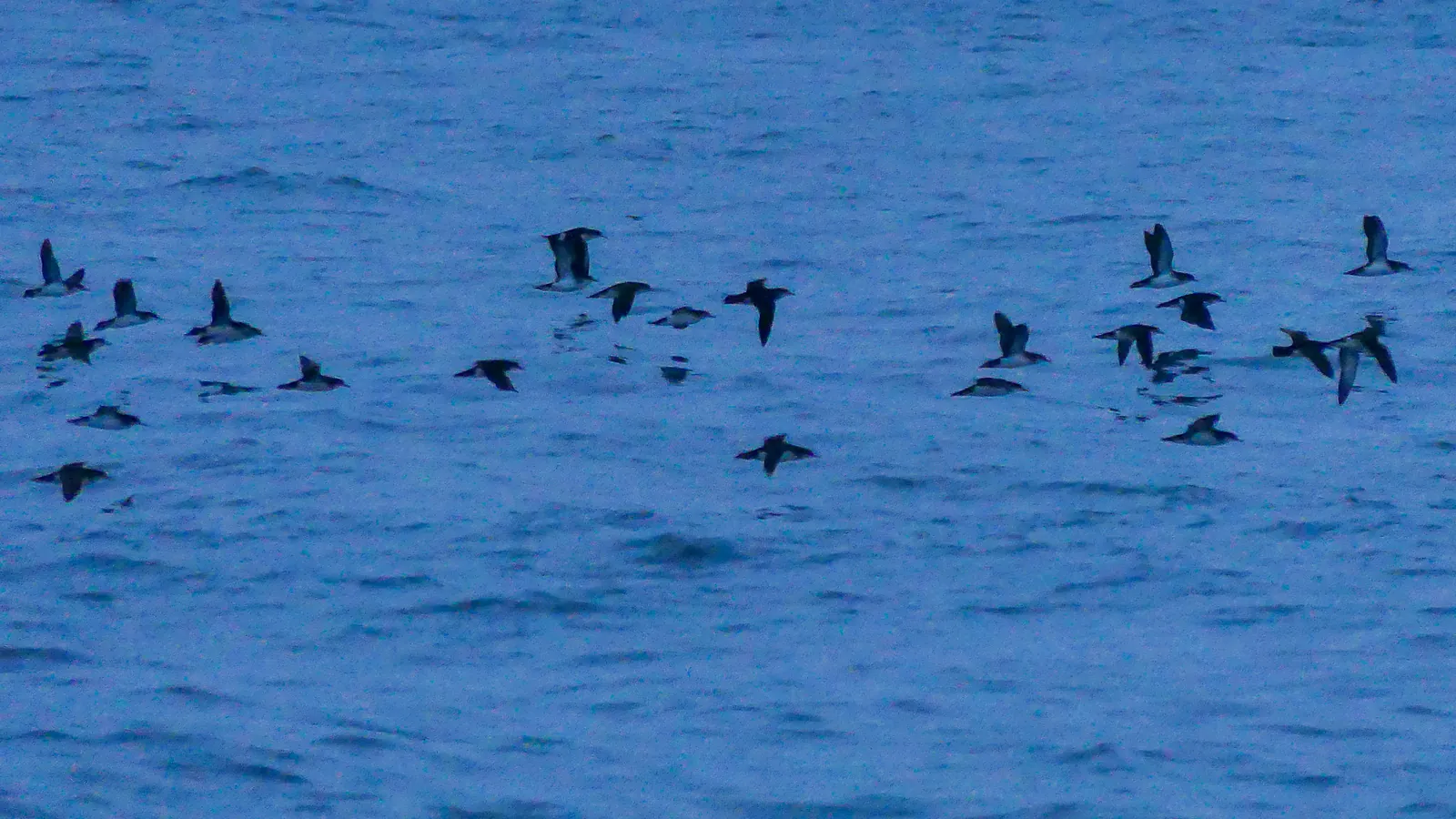
Manx Shearwaters are migratory seabirds that spend the non-breeding season in the South Atlantic. BTO describes their arrival in late winter or early spring and continued reporting into early autumn as birds head south. For a visitor, the useful question is which experience fits the date: a watch over coastal water, a boat journey through feeding areas or a stay on an island with authorised evening wildlife activity.
Our choice for a first attempt is late spring or summer in an established western sea-watching area, with several opportunities to look rather than one short stop. Use the linked guide’s target months alongside its recent-sightings source. A local report helps decide where to spend a session, while the broader season explains why an apparently suitable viewpoint can be quiet on a particular day.
August and September can still be relevant for offshore watching, even when some other seabird attractions have changed. Skomer’s current wildlife timeline explicitly includes Manx Shearwaters through September. Avoid applying the Puffin season to every species on the same island. If your purpose is evening colony activity, match the booking to what the operator actually offers and leave room for weather affecting arrival or departure.
Look for a bird flying low over the water with narrow, stiff wings, dark upperparts and a pale underside. The RSPB describes a sequence of quick flaps followed by glides and banking turns. Watch a bird through several changes of angle: the contrast between the upper and lower surface may be much clearer during a bank than when it is flying directly away.
Begin with binoculars so you can follow a moving bird, then use a telescope if the distance and conditions justify it. Find a fixed point in the view and practise keeping the bird in sight as it passes that point. Resist changing magnification repeatedly during a brief encounter. A stable, wider image is often more useful than a larger view that you lose behind every wave.
Do not rely on a single white flash or assume every low dark seabird is a Manx Shearwater. Note the shape, wing action, height above the water and the pattern of dark and pale areas that you genuinely saw. If conditions make identification difficult, stay with the birds you can recognise and learn from their movement. A careful description is a better result than an unsupported rare-shearwater identification.
A public coastal viewpoint is the most flexible option. You can choose the duration, return when visibility improves and leave if exposure becomes unpleasant. Use an official viewpoint with a secure position for binoculars or a tripod. The best-looking ledge on a photograph may be unsuitable for a prolonged watch, and approaching an edge will not solve poor offshore visibility.
A boat journey gives a different angle and can bring feeding or resting groups into view, but choose the product carefully. A transfer to an island, a general wildlife cruise and a dedicated sea-birding excursion have different purposes. Ask what the trip concentrates on and how much offshore watching it includes. Work with the crew’s chosen viewing distance rather than requesting that the boat move into a resting flock.
Our preference is to choose the experience you can enjoy even if the shearwaters stay distant. A coastal session can be combined with a reserve walk; an island transfer also offers the island itself. Carry binoculars where you can reach them safely and protect equipment from spray. Read the operator’s current arrangements and the individual guide before paying for a trip whose central attraction depends on conditions at sea.
BTO describes Manx Shearwaters as nocturnal at their breeding colonies. Their nesting areas can therefore look deceptively quiet by day, while many birds are out at sea or hidden below ground. A day visit to a famous shearwater island should be planned around the visible landscape and its other wildlife as well as any offshore opportunities. Learning this before departure prevents an unnecessary search through fragile turf.
A booked stay changes the possibilities because you remain after day visitors have left. Skomer and Skokholm offer different forms of overnight island experience, and Skokholm’s operator specifically describes the night-time activity of shearwaters and Storm Petrels. Follow the wardens’ advice about the appropriate route and session. Their briefing should determine how you move and use lights once it is dark.
Keep the evening simple. Sort clothing and equipment before leaving the accommodation, know the agreed way back and avoid trying to combine birdwatching with an unfamiliar cross-island walk. The soundscape can be as memorable as a close view. Give it time without using calls to attract birds, handling them or searching for an opening in the ground. Photography must fit the operator’s wildlife instructions.
Skomer is our choice when you want a substantial Welsh seabird island visit with the option of a separately booked stay. Its operator’s seasonal timeline helps distinguish the shearwater period from the shorter peak for some auks. Use the Skomer guide to compare the day trip with accommodation and authorised activities. Keep practical booking windows and boat arrangements there so that you are planning from the right year’s information.
Skokholm suits visitors who want to settle into island life rather than fit it between several mainland stops. The Trust describes stays with a minimum number of nights that changes across the season, so start with the Skokholm guide and current booking information. Choose the length of stay for the whole experience, including repeated daytime watches and evenings under the wardens’ guidance, rather than expecting a brief unscheduled landing.
Rum offers a different Scottish island setting. NatureScot identifies a major Manx Shearwater colony and offshore rafts, but its mountainous terrain makes it a very different proposition from an easy harbour-side birdwatch. Use the Rum guide and official visitor advice to plan a suitable public route and island stay. The colony’s importance is a reason to protect it, not a reason to improvise a night-time climb towards breeding slopes.
Give the session a clear beginning and end. Scan a manageable strip of sea, follow a few birds properly, then pause to rest your eyes. Choose a background against which movement is visible rather than trying to inspect the entire horizon continuously. Make a note of weather, visibility and the direction of passage, keeping the description separate from any uncertain identification.
If you are watching with someone more experienced, agree a simple way to point out birds using a fixed landmark or an obvious vessel. Spend time learning the regular birds in the view; that gives the next unfamiliar shape something to be compared with. Avoid a crowded, moving tripod setup where people cannot pass safely. A short steady watch can teach more than a long session spent struggling with equipment.
Our choice in poor conditions is a shorter, sheltered alternative with an easy exit. Strong wind does not oblige you to remain on an exposed headland, and the chance of an interesting bird never outweighs secure footing. The sea-watching fieldcraft lesson and coastal-waters page below help with the broader approach. Return to the individual reserve guide for the actual safe watching area and practical arrangements.
Seabird islands depend on careful biosecurity, particularly against introduced ground predators. Follow the operator’s luggage and food instructions before travelling, keep bags securely closed and report any concern to staff. Carry rubbish away as directed. These routines are part of a successful island trip, and they begin before you step onto the boat.
After the visit, share observations with a useful date and public locality description while keeping sensitive breeding details private. A photograph of a bird offshore or a description of the evening soundscape can explain the experience without exposing a burrow location. Choose the next trip for a different view of the same birds: a patient mainland sea watch after an island stay can make their life at sea much easier to appreciate.
These rows use existing reserve watching-place records and typical local seasons. Sensitive locations are withheld. Follow current operator restrictions.
| Reserve and public watching place | Typical months | Best light | Scope |
|---|---|---|---|
| Skomer Island: Skomer Head (public path) | April, May, June, July, August, September | either | essential |
| RSPB South Stack: Ellin’s Tower and outside viewpoint | April, May, June, July, August, September | morning | useful |
| Spurn National Nature Reserve: Public Seawatch Hide | May, June, July, August, September, October | either | essential |
| Mull of Galloway: Public high-point sea views around the reserve | April, May, June, July, August, September, October | either | essential |
| Portland Bird Observatory and Portland Bill: Bill tip public seawatching ground | April, May, June, July, August, September | either | essential |
| Flamborough Head and Flamborough Bird Observatory: Seawatch Observatory | August, September, October | either | essential |
| RSPB Sumburgh Head: The Lookout accessible sheltered viewing platform | May, June, July, August, September | either | essential |
| RSPB Coll: Hogh Bay — permitted beach-route shore end | April, May, June, July, August, September | either | essential |
| Isles of Scilly: Operator-run pelagic from St Mary’s | June, July, August, September, October | not applicable | not needed |
The months below come from each reserve’s local birding guide. They describe typical presence or a preferred watching season; national occurrence can be broader. Reports show past observations and cannot promise an encounter. Sensitive birds have no published watching position.
| Species | Reserve guide | Typical or preferred months |
|---|---|---|
| Manx Shearwater | Skomer Island | April, May, June, July, August, September |
| Manx Shearwater | RSPB South Stack | April, May, June, July, August, September |
| Manx Shearwater | RSPB Ramsey Island | April, May, June, July, August, September |
| Manx Shearwater | Spurn National Nature Reserve | May, June, July, August, September, October |
| Manx Shearwater | Mull of Galloway | April, May, June, July, August, September, October |
| Manx Shearwater | Portland Bird Observatory and Portland Bill | April, May, June, July, August, September |
| Manx Shearwater | Flamborough Head and Flamborough Bird Observatory | August, September, October |
| Manx Shearwater | RSPB Sumburgh Head | May, June, July, August, September |
| Manx Shearwater | Lunga and the Treshnish Isles | June |
| Manx Shearwater | RSPB Coll | April, May, June, July, August, September |
| Manx Shearwater | Bardsey Island and Bird Observatory | March, April, May, June, July, August, September |
| Manx Shearwater | Skokholm Island | April, May, June, July, August, September |
| Manx Shearwater | Isle of Rum National Nature Reserve | March, April, May, June, July, August, September |
| Manx Shearwater | St Kilda | April, May, June, July, August, September |
| Manx Shearwater | Isles of Scilly | June, July, August, September, October |
| Manx Shearwater | Lundy | April, May, June, July, August, September |
Public places covered in this guide include Skomer Island, RSPB South Stack, RSPB Ramsey Island.
Typically spring to early autumn around British waters; colony attendance and visitor access vary by island. Skomer’s operator gives April–September.
Keep to authorised island paths, follow the wardens’ night-watching and lighting instructions, and leave burrows undisturbed. Watch offshore birds from safe public views or operator-run boats.
Reviewed 2026-10-19.